
Introduction
The AI Revolution in Recruitment
The hiring landscape is undergoing its most significant transformation in decades. Major platforms like LinkedIn and Indeed are rolling out sophisticated AI-powered recruiting tools, marking a clear inflection point: AI in recruitment has moved from experimental to essential.
Why HR Leaders Are Betting Big on AI
Recent research from BCG reveals a striking pattern among companies exploring artificial intelligence. When organizations experiment with AI, seven out of ten are implementing it first in their HR departments—and recruiting tops the list of use cases.
The logic is straightforward. Recruiting involves countless repetitive tasks—writing job descriptions, parsing resumes, scheduling interviews, sending follow-up emails. These administrative burdens consume hours that recruiters could spend on what humans do best: building relationships, evaluating cultural fit, and selling candidates on opportunities.
Early adopters are already seeing the payoff. The overwhelming majority of companies using AI in recruitment—92%—report tangible benefits. Even more impressive, one in ten organizations has achieved productivity improvements exceeding 30%, freeing up recruiters to focus on strategic work rather than administrative drudgery.
The Candidate Experience Imperative
But there’s a critical balance to strike. While AI delivers speed and efficiency, the human experience can’t be sacrificed in pursuit of automation. Research shows that more than half of job seekers would walk away from an attractive offer if the recruiting process left them frustrated or disrespected.
This creates a paradox: companies need AI to compete for talent, but poor implementation can drive away the very candidates they’re trying to attract. The winners will be organizations that use AI to enhance—not replace—the human elements that matter most to candidates.
From Resume Screening to Strategic Talent Planning
The most forward-thinking companies aren’t just using AI to do old tasks faster. They’re fundamentally rethinking what recruiting looks like. Instead of spending 20+ hours manually screening resumes for each position, recruiters are using AI to handle initial vetting while they focus on proactive talent pipeline development and relationship building.
The shift is dramatic: recruiters moving from reactive (waiting for applications) to proactive (identifying future needs before positions open), from administrative (scheduling and paperwork) to strategic (workforce planning and talent mapping).
Making the Right Choice
With AI recruiting now table stakes rather than competitive advantage, the critical question shifts from “Should we use AI?” to “Which platform should we choose, and how do we implement it effectively?”
That’s exactly what this guide addresses. We’ve analyzed the 15 leading AI recruiting platforms available in 2025, evaluating their capabilities, pricing structures, and real-world results to help you make an informed decision that fits your organization’s specific needs and hiring challenges.
- Introduction
- What Is AI Recruitment Software?
- Why AI Recruitment Software Matters in 2025
- How We Selected the Best AI Recruiting Tools
- Top 15 AI Recruiting Platforms [Quick Comparison]
- 15 Best AI Recruiting Software: Detailed Reviews
- AI Recruiting Software by Use Case
- How to Choose the Right AI Recruiting Platform
- Implementation Guide: Rolling Out AI Recruiting
- Future of AI in Recruiting (2025-2030)
- Frequently Asked Questions
- AI Recruiting Glossary of Terms
TL;DR
Hiring the right talent shouldn’t feel like searching for a needle in a haystack. Yet, with an average of 250 resumes flooding in for every job posting and recruiters spending 23 hours screening candidates for a single hire, the traditional recruiting process has become a bottleneck that slows growth and drains resources.
AI recruitment software is transforming how companies find, screen, and hire talent by automating time-consuming tasks while improving the quality of candidates who make it through your pipeline. These platforms use machine learning, natural language processing, and conversational AI to handle everything from resume screening to conducting first-round interviews automatically.
In this comprehensive guide, you’ll discover:
- Top 15 AI recruiting platforms compared across features, pricing, and ideal use cases
- How to choose the right solution based on your company size, budget, and hiring needs
- ROI metrics and implementation guidance to ensure successful adoption
- Future trends in AI recruiting to help you stay ahead of the curve in your role.
Quick Takeaways
AI Hiring Platform with AI interviewer + pre-vetted candidates
Cost-effective choices with easy ramp-up for small teams.
Robust feature sets and advanced integrations for large orgs.
Built for scaling hiring pipelines and heavy throughput.
Day-one value with quick setup and onboarding.
Let’s dive into what makes AI recruitment software essential in 2025 and how to choose the perfect platform for your team.
What Is AI Recruitment Software?
AI recruitment software leverages AI to automate and optimize the hiring process. Unlike traditional Applicant Tracking Systems (ATS) that simply organize candidate data, AI recruiting platforms actively help you source, analyze, evaluate, and make intelligent recommendations about candidates.
At its core, AI recruitment software transforms hiring from a manual, gut-feeling process into a data-driven operation. These platforms can automatically source candidates across multiple channels, screen hundreds of resumes in minutes, conduct preliminary interviews through conversational AI, and rank candidates based on their fit for specific roles.
Key Technologies Powering AI Recruiting
Modern AI recruiting platforms combine several cutting-edge technologies:
Natural Language Processing (NLP) enables systems to understand and interpret human language in resumes, job descriptions, and candidate responses. This goes far beyond simple keyword matching, NLP can identify relevant skills, understand context, and even detect communication patterns that indicate culture fit.
Machine Learning algorithms improve over time by analyzing successful hires and failed matches. The system learns what characteristics predict success in your organization and adjusts its candidate scoring accordingly.
Conversational AI powers chatbots and automated interviewers that can engage candidates in natural dialogue. JusRecruit’s Saina AI interviewer, for example, conducts structured phone conversations that evaluate technical skills, problem-solving abilities, and cultural alignment = compressing what typically takes weeks of phone screens into hours.
Computer Vision technology analyzes video interviews to assess communication skills, enthusiasm, and other soft skills indicators (though this remains controversial and requires careful ethical implementation).
Core Functions of AI Recruiting Software

- Candidate Sourcing: Automatically discovers potential candidates across job boards, social media platforms, professional networks, and proprietary databases, often finding passive candidates who aren’t actively applying.
- Resume Screening: AI parsing goes beyond simple keyword matching to understand context, identify transferable skills, detect gaps or inconsistencies, and evaluate career trajectory patterns.
- Candidate Matching: Skills-based ranking systems score and prioritize applicants based on how well they align with job requirements, creating a shortlist of top matches automatically.
- Interview Automation: Advanced platforms like JusRecruit can conduct actual first-round interviews through AI. It asks relevant questions, evaluates responses, and generates detailed scorecards all without human intervention in the initial stages.
- Analytics & Insights: Comprehensive dashboards track pipeline metrics, identify bottlenecks, detect potential bias in hiring decisions, and use predictive analytics to forecast hiring success.
Real-World Impact
The impact of AI recruiting is measurable and significant. Companies implementing these solutions report reducing time-to-hire by 30-50%, with some organizations achieving even more dramatic results. When Unilever implemented AI video interviewing, they cut their hiring process from 4-6 months down to just a few weeks a 90% reduction in time-to-hire while saving over 50,000 hours and £1 million annually.
The transformation isn’t just about speed. Organizations also report that candidates flagged as strong by AI systems are 14% more likely to receive job offers and tend to perform better long-term, demonstrating that automation can actually improve hiring quality when implemented thoughtfully.
Why AI Recruitment Software Matters in 2025
The case for AI recruitment software has never been stronger. As we move through 2025, three compelling factors are driving rapid adoption across organizations of all sizes.
Time-to-Hire Reduction Statistics
Time is the most precious resource in modern recruiting. Every day a critical role remains unfilled costs companies an estimated $500 in lost productivity and revenue. Traditional hiring timelines have become unsustainable in competitive talent markets.
AI recruiting platforms dramatically compress these timelines:
Resume Screening: What once took recruiters 20-23 hours per hire now takes 2-3 hours a 75% time reduction. AI systems can evaluate hundreds of resumes in the time it takes a human recruiter to review a handful.
Interview Scheduling: Automated scheduling eliminates the back-and-forth email chains that typically consume 3-5 hours per hire, achieving 90% time savings through instant calendar coordination.
First-Round Interviews: This is where platforms like JusRecruit shine. Traditional phone screens require scheduling individual 15-30 minute calls with each candidate, a process that can stretch across multiple weeks due to calendar conflicts. With AI phone screens via Saina, this entire stage compresses from weeks to hours candidates complete interviews at their convenience, and hiring teams review scored results whenever they’re ready.
Real data from adopting companies reinforces these benefits. Research indicates that organizations using AI in recruitment achieve 30-50% improvements in overall hiring speed. An Indian IT services company reported a 40% reduction in time-to-hire after implementing AI, filling critical positions in just 15 days instead of 25.
Cost Savings Data
The financial case for AI recruiting is equally compelling. Traditional hiring carries significant hidden costs that most organizations underestimate.
Industry Baseline: The average cost per hire hovers around $4,000-$5,000 when accounting for recruiter time, job board fees, assessment tools, and other expenses. For specialized or senior roles, this figure can double or triple.
AI Recruiting ROI Breakdown:
Recruiter time represents one of the largest cost centers. At a conservative estimate of $40 per hour for recruiter labor:
- Traditional screening: 23 hours × $40 = $920 per hire
- With AI screening: 3 hours × $40 = $120 per hire
- Savings: $800 per hire just on screening
Agency fees are even more dramatic. Recruitment agencies typically charge 15-25% of the first-year salary for placements. For a $60,000 position, that’s $9,000-$15,000 per hire. JusRecruit’s pre-vetted candidate pool eliminates these markups entirely, providing access to qualified, interview-ready candidates without percentage-based fees.
Vacancy costs compound daily. Every unfilled position represents lost revenue, delayed projects, and increased burden on existing team members. Reducing time-to-hire from 40 days to 20 days saves approximately $10,000 in vacancy costs per role.
Practical Calculation Example:
For startups and mid-market companies operating on tight budgets, these savings can be transformational representing additional headcount, expanded marketing spend, or improved runway.
Quality of Hire Improvements
Speed and cost savings mean nothing if you’re hiring the wrong people. Fortunately, AI recruiting platforms often improve hiring quality alongside efficiency gains.
Quality of hire is measured through several key metrics:
90-Day Retention Rates: Industry benchmarks suggest 70-80% of new hires remain past the 90-day mark. Organizations using AI recruitment report retention rates of 85-90%, indicating better initial matches between candidates and roles.
Time to Productivity: New employees typically need 60-90 days to reach full productivity. AI-vetted candidates, who are pre-qualified on key skills and cultural factors, often reach productivity benchmarks 20-30% faster.
Hiring Manager Satisfaction: Perhaps the most telling metric is whether hiring managers are happy with their new team members. Surveys of companies using AI recruiting show 70% of recruiters report improved candidate quality compared to traditional methods.
Why does AI improve quality? Several factors contribute:
Skills-based matching goes beyond resume keywords to identify candidates who possess the actual competencies needed for success. JusRecruit’s Saina AI interviewer asks role-specific questions that probe practical knowledge and problem-solving ability, surface indicators that resumes can’t capture.
Reduced bias through standardization ensures every candidate answers the same questions and is evaluated against consistent criteria. Human interviewers have off days, personal biases, and varying standards. AI applies the same rigorous evaluation to everyone.
Better cultural fit assessment emerges from structured conversations that explore work style preferences, communication patterns, and values alignment dimensions that keyword-stuffed resumes fail to convey.
The Forbes data point is particularly striking: candidates flagged as strong by AI systems are 14% more likely to receive job offers and succeed in subsequent interview rounds compared to those selected through traditional resume review alone.
How We Selected the Best AI Recruiting Tools
Choosing the right AI recruiting platform requires evaluating multiple dimensions of functionality, usability, and value. Our selection process for this guide involved rigorous analysis across seven key criteria.
Selection Criteria
1. Core Recruiting Functionalities (30% weighting)
The foundation of any recruiting platform must be solid, regardless of AI capabilities. We evaluated:
- ATS capabilities for managing candidate pipelines and workflows
- AI-powered candidate sourcing across multiple channels
- Resume screening and ranking sophistication
- Interview automation features and quality
- Job posting distribution reach
- Analytics and reporting depth
Platforms that excel here combine comprehensive ATS functionality with genuinely useful AI features, rather than bolting superficial “AI” labels onto legacy systems.
2. AI-Specific Features (25% weighting)
This is where differentiation happens. We assessed:
- Candidate matching accuracy and relevance of AI recommendations
- Chatbot and conversational AI quality can it handle natural dialogue or just scripted responses?
- Bias reduction capabilities and transparency in decision-making
- Predictive analytics for hiring success forecasting
- Video interview intelligence (where applicable)
JusRecruit’s Saina AI interviewer scored particularly high here, as it conducts actual conversational interviews rather than simple chatbot screening, providing deeper candidate evaluation.
3. Usability & User Experience (15% weighting)
The best features are worthless if teams won’t use them. We evaluated:
- Dashboard intuitiveness and information architecture
- Setup and onboarding ease can a non-technical user get started quickly?
- Mobile accessibility for on-the-go recruiting
- Learning curve and documentation quality
4. Integration Ecosystem (10% weighting)
Modern recruiting tools must play nicely with existing systems:
- ATS integrations (for companies keeping existing solutions)
- HRIS connections (BambooHR, Workday, etc.)
- Job board partnerships and posting automation
- Communication tools (Slack, Teams, Gmail)
- Background check and assessment integrations
5. Value for Money (10% weighting)
We considered:
- Pricing transparency and clarity
- ROI potential based on time and cost savings
- Free trial availability for testing before commitment
- Scalability as hiring needs grow
6. Customer Support (5% weighting)
When hiring is time-sensitive, responsive support matters:
- Response time and availability
- Support channels (email, chat, phone)
- Knowledge base comprehensiveness
- Onboarding and training resources
7. Customer Reviews (5% weighting)
Real user experiences provide invaluable insights:
- G2 and Capterra ratings and review quality
- User satisfaction scores across reviewer segments
- Adoption rates and feature utilization
- Common praise and complaint patterns
Evaluation Process
Our methodology combined multiple research approaches:
Hands-on testing with trial accounts where available allowed us to experience the platforms firsthand as both recruiters and candidates.
Vendor demos and documentation review provided deeper insights into advanced features and configuration options.
Customer interview insights from recruiting professionals currently using these tools offered real-world perspective on what works and what doesn’t.
Third-party review analysis across G2, Capterra, and industry publications helped identify consistent patterns in user experiences.
Industry expert consultations with talent acquisition leaders and HR technology analysts validated our assessments.
Transparency Note
This review prioritizes platforms suitable for startups to mid-market companies, with emphasis on ease of implementation and measurable ROI. While we’ve included some enterprise-focused solutions for comparison, our primary focus is tools that deliver value quickly without requiring months of implementation and six-figure budgets.
Top 15 AI Recruiting Platforms [Quick Comparison]
Here’s a quick overview of our top 15 picks. Each platform excels in different areas scan this table to identify your best matches, then dive into detailed reviews below.
| Platform | Best For | Free Trial | Key AI Feature | Rating |
|---|---|---|---|---|
| JusRecruit | Startups, high-volume hiring, any role | 14 days | AI interviewer (Saina) + pre-vetted pool | ★★★★★ |
| Workable | SMBs prioritizing qualified candidates | 15 days | AI candidate ranking | ★★★★ |
| Greenhouse | Content generation, enterprise | Demo | AI-powered job descriptions | ★★★★★ |
| Humanly | Candidate engagement automation | Demo | AI chatbot screening | ★★★★★ |
| Canditech | Skills assessments + video | Yes | AI assessment builder | ★★★★★ |
| Pinpoint | Automated screening | Demo | AI resume parsing | ★★★★ |
| SeekOut | Sourcing hard-to-find talent | 14 days | AI diversity sourcing | ★★★★ |
| Gem | Multi-platform engagement | Demo | AI outreach automation | ★★★★ |
| Fetcher | Automated outreach | Demo | AI sourcing engine | ★★★★ |
| Manatal | Customizable pipelines | 14 days | AI enrichment | ★★★★ |
| Boon | Employee referrals | Demo | AI referral matching | ★★★★ |
| Recruit CRM | Email sequencing | Yes | AI email automation | ★★★★ |
| Checkr | Background screening | No | AI compliance checks | ★★★★ |
| iCIMS | Remote teams | Demo | AI multilingual screening | ★★★★ |
| Jobvite | Hiring strategy optimization | Demo | AI analytics | ★★★★ |
💡 Quick Tip: For startups and fast-growing companies hiring across multiple roles, JusRecruit offers the best all-in-one value with AI interviews, ATS, and pre-vetted candidates no need to juggle multiple tools or pay expensive agency fees.
15 Best AI Recruiting Software: Detailed Reviews
1) JusRecruit
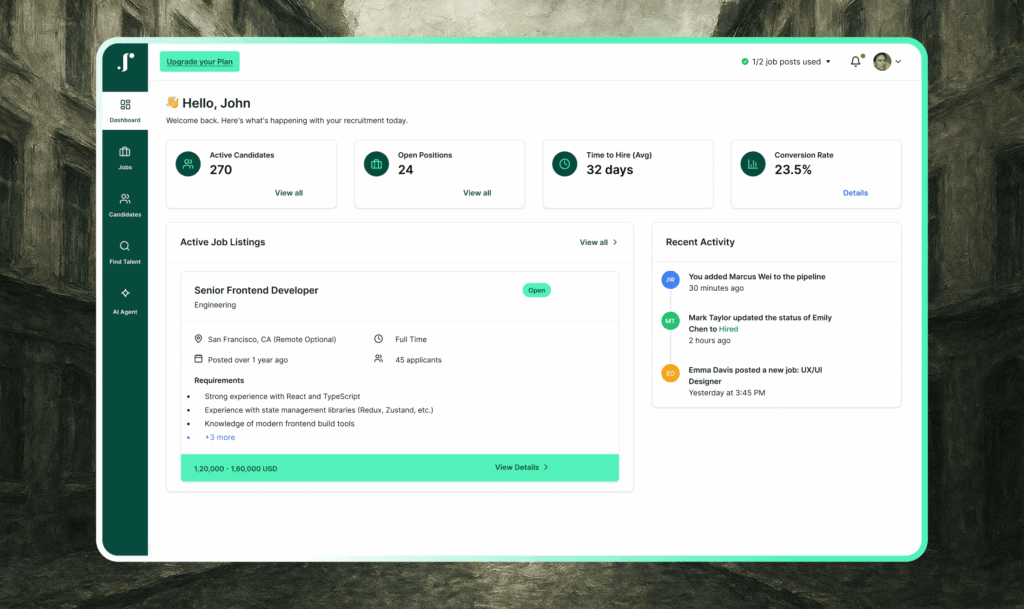
Best for: Startups and mid-market companies hiring across multiple functions
Starting Price: Custom pricing | Free Trial: 14 days | Setup Time: Day 1 value
Overview
JusRecruit stands out as the only AI recruiting platform that combines three essential capabilities in one seamless solution: a lightweight ATS with job board integration, AI-powered first-round interviews via Saina, and a pre-vetted candidate pool all designed for teams that need to hire fast without sacrificing quality.
Unlike legacy platforms built for large enterprises with complex implementation timelines, JusRecruit targets startups and growing companies with a product-led approach. The platform offers self-serve setup, transparent pricing, and immediate value from day one. This makes it ideal for lean HR teams that can’t afford long implementations, expensive agency fees, or the overhead of managing multiple disconnected recruiting tools.
The vision is simple but powerful: give recruiters no fluff, just talent. Every feature is designed to eliminate early funnel chaos and help teams focus on what actually matters interviewing strong matches and making confident hiring decisions.
Standout Features
- Saina AI Interviewer: Conducts 10-15 minute conversational phone/video interviews automatically, generating comprehensive scorecards with evidence-backed recommendations
- Pre-Vetted Candidate Pool: On-demand access to candidates who’ve completed Saina interviews for similar roles, eliminating agency fees (15-25% of salary)
- Lightweight ATS: Post to 2,500+ job boards, customizable pipelines, team collaboration tools, mobile access all without enterprise complexity
- Day-One Value: Create jobs, enable AI vetting, configure Saina interviews, and start reviewing candidates immediately with no IT involvement
Pros and Cons
Pros: ✅ All-in-one platform eliminates need for multiple tools (ATS + AI interviews + candidate sourcing)
✅ Significant time savings on early-stage screening (weeks compressed to hours)
✅ No agency fees for pre-vetted candidates (15-25% salary savings per hire)
✅ Fast setup with product-led growth approach (day-one value)
✅ Transparent pricing (rare in recruiting software)
✅ Works for any role, not just technical positions
✅ Built specifically for startups and SMBs rather than enterprise-first with scaled-down versions
✅ Saina AI interviewer provides genuine conversational assessment, not scripted chatbot interactions
Cons: ⚠️ Newer platform compared to 10+ year old competitors (though this means modern architecture)
⚠️ Pre-vetted candidate pool still growing (expanding monthly as more candidates complete Saina interviews)
⚠️ Advanced enterprise features like SSO still in development
Pricing
JusRecruit offers transparent, straightforward pricing:
- Starter: Core ATS with AI vetting for inbound applications
- Professional: Adds Saina AI interviews for unlimited roles
- Enterprise: Includes pre-vetted candidate pool access, advanced analytics, and API access
Free Trial: 14 days with full access, no credit card required
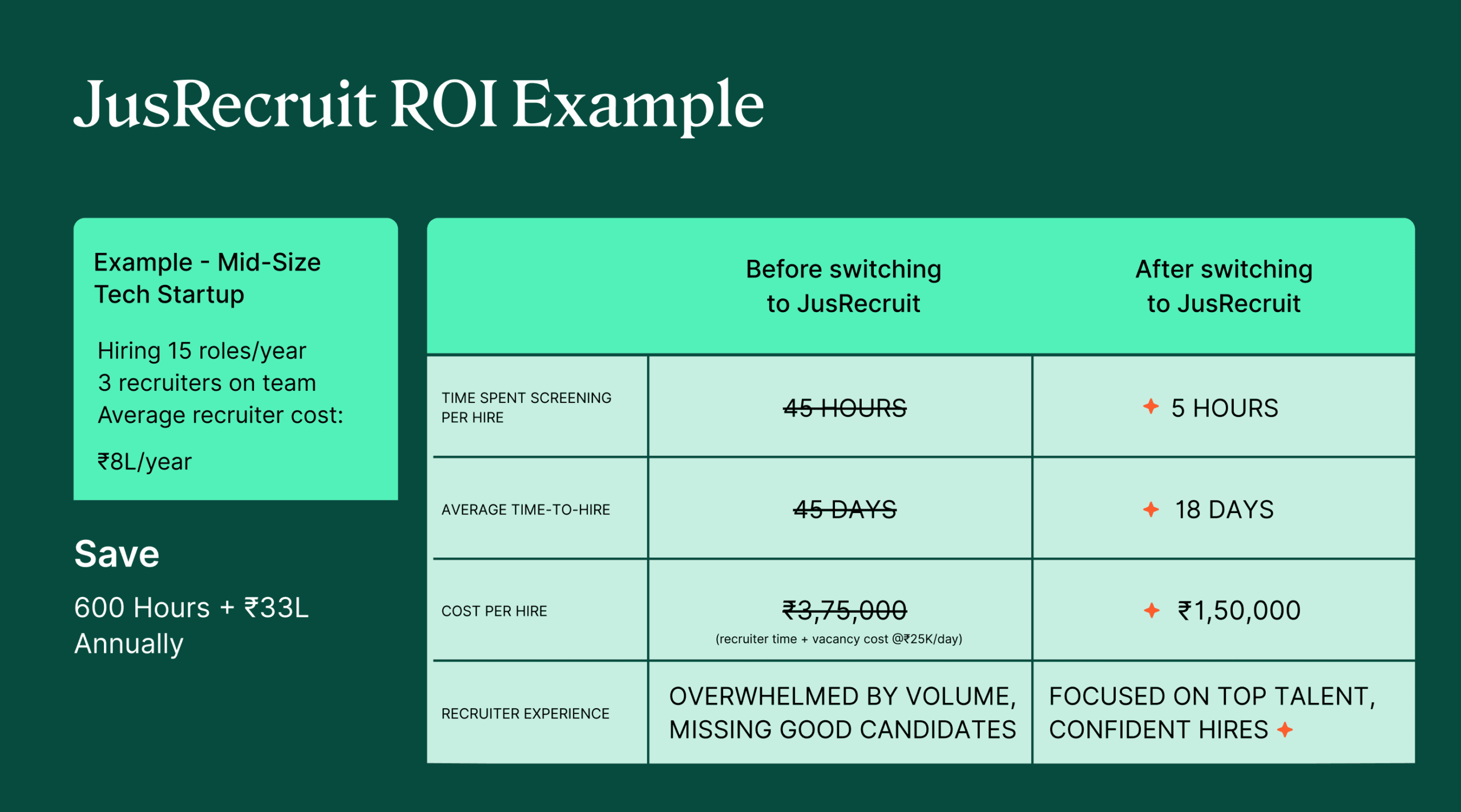
ROI Example:
Start Free Trial
With JusRecruit, you can use AI phone screens to cut your screening time from 2 weeks to mere 3 days.
2) Workable Recruiting
Best for: SMBs prioritizing candidate quality and pipeline management
Starting Price: $299/month | Free Trial: 15 days
Overview
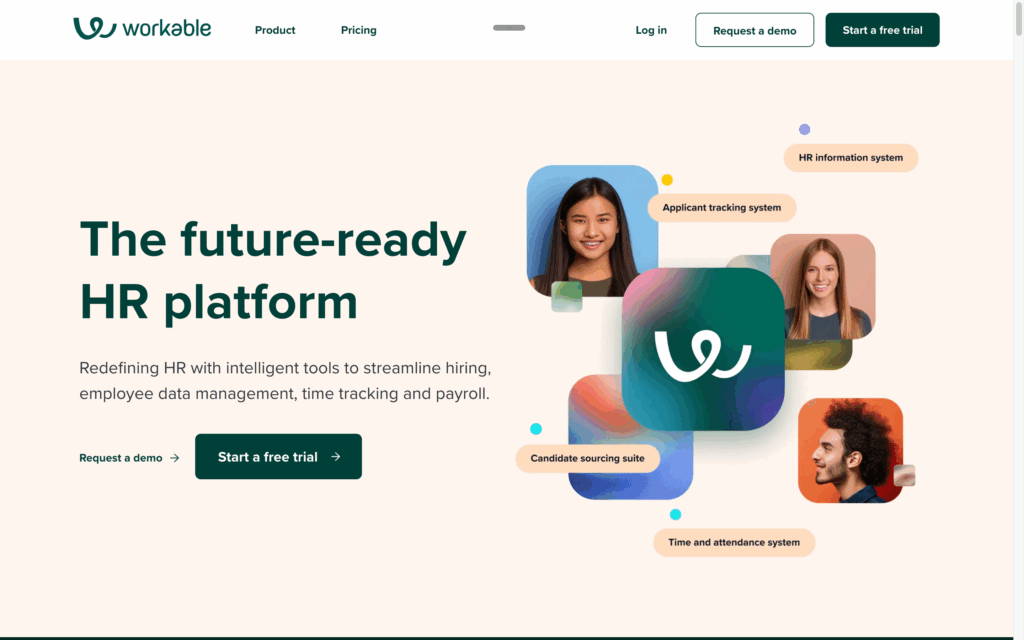
Workable has established itself as a reliable mid-market ATS with increasingly sophisticated AI capabilities that help companies manage high application volumes effectively. The platform’s AI Recruiter automatically identifies and ranks top candidates based on your specific criteria, significantly reducing the manual effort required for resume screening.
With over 200 job board integrations and a mobile-first approach, Workable makes it easy to post jobs widely and manage candidates on the go. The platform strikes a balance between comprehensive functionality and usability, making it accessible for companies with dedicated HR teams who want to improve their hiring efficiency. It’s particularly strong for organizations receiving hundreds of applications per role and needing better tools to surface the best matches quickly.
Standout Features
- AI Recruiter: Automatically ranks candidates by fit score based on job requirements, highlighting top matches
- Passive candidate sourcing: Discovers candidates not actively applying through database searches and social media
- One-click job posting: Distribute openings to 200+ job boards simultaneously
- Interview kits: Customizable scorecards for consistent evaluation across interviewers
- Mobile app: Full recruiting workflow accessible on-the-go
- Strong analytics: Pipeline bottleneck identification and time-to-hire tracking
Pros and Cons
Pros: ✅ Mature ATS with solid AI layer built on years of development
✅ Strong candidate prioritization reduces screening time
✅ Good fit for mid-market companies with established HR teams
✅ Extensive integrations with popular HR tools
Cons: ⚠️ Can be pricey for early-stage startups on tight budgets
⚠️ AI features less advanced than JusRecruit’s interview automation
⚠️ Search functionality could be more intuitive
⚠️ Some users report the interface feels dated compared to newer platforms
Pricing
Starting at $299/month for basic plans. Custom pricing for larger teams with advanced needs. Contact sales for detailed quotes.
3) Greenhouse
Best for: Enterprise companies needing AI-powered content generation
Starting Price: Custom pricing | Free Trial: Demo available
Overview
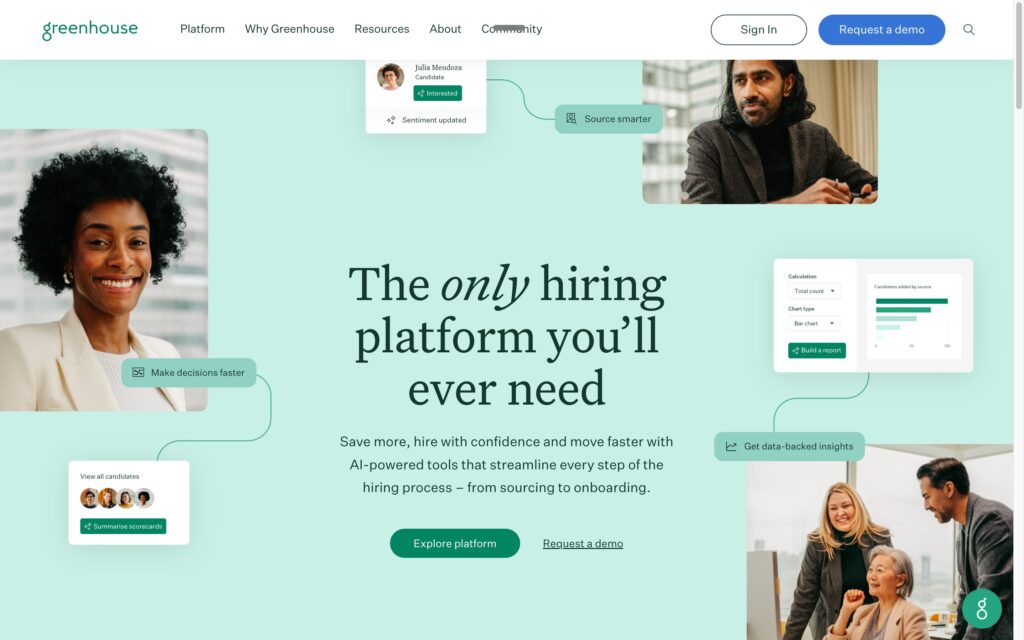
Greenhouse is an industry-leading enterprise ATS that has strategically integrated AI to enhance content creation, bias reduction, and hiring consistency across large organizations. The platform excels at using generative AI for job description writing, interview question generation, and candidate communications helping maintain consistent employer branding at scale across departments and locations. With comprehensive compliance features, structured hiring frameworks, and an ecosystem of 400+ integrations, Greenhouse is built for companies that need sophisticated hiring operations with proper governance.
The platform’s structured hiring methodology ensures every candidate is evaluated against the same criteria, reducing variability in hiring decisions. While it requires significant implementation time and investment, Greenhouse delivers enterprise-grade reliability and features for organizations where hiring compliance and consistency are paramount.
Standout Features
- AI content generation: Creates job posts, outreach emails, and interview guides tailored to roles
- Resume anonymization: Removes bias-inducing information to promote fair evaluation
- Structured hiring framework: Ensures consistent evaluation across all candidates
- Diversity analytics: Track and improve DEI metrics throughout the hiring pipeline
- Extensive app marketplace: 400+ integrations for every HR need
Pros and Cons
Pros: ✅ Industry-leading ATS with sophisticated AI enhancements
✅ Strong bias mitigation tools for improving diversity
✅ Comprehensive analytics and reporting
✅ Best-in-class integrations ecosystem
Cons: ⚠️ Enterprise-focused, which means complex for small teams
⚠️ Higher price point puts it out of reach for many startups
⚠️ Longer implementation time (weeks to months) vs. JusRecruit’s day-one value
⚠️ Can feel over-engineered for companies with straightforward hiring needs
Pricing
Custom pricing based on company size, number of users, and feature requirements. Contact for detailed quote. Typically positioned for companies with 50+ employees.
4) Humanly
Best for: High-volume hiring with automated candidate engagement
Starting Price: Custom | Free Trial: Demo
Overview
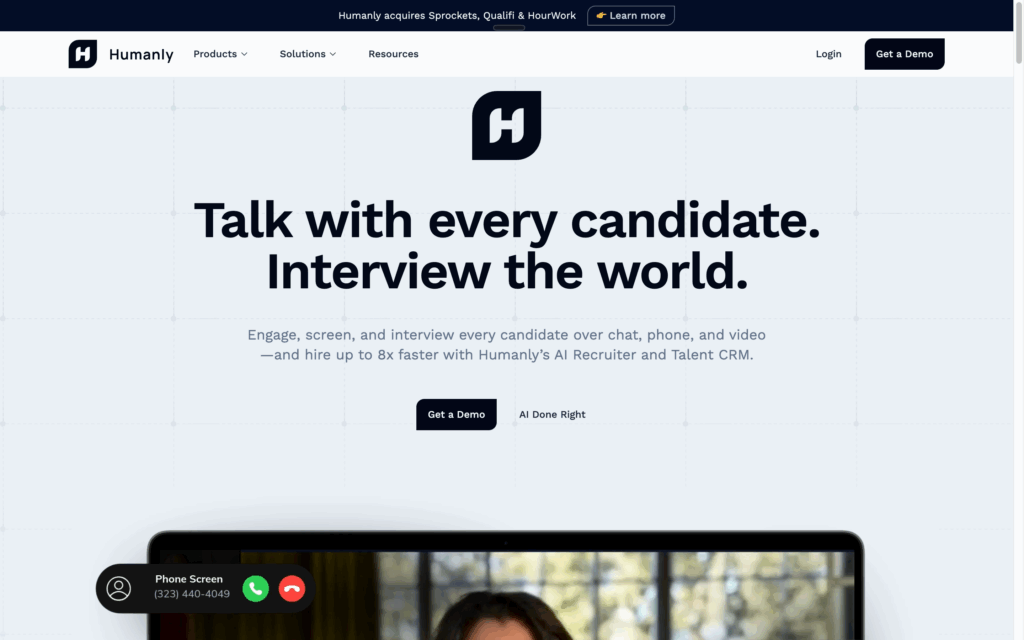
Humanly specializes in conversational AI for high-volume recruiting scenarios where consistent candidate engagement is critical but humanly impossible at scale. The platform’s AI chatbots handle screening conversations, schedule interviews automatically, and keep hundreds or thousands of candidates engaged simultaneously through personalized SMS and email campaigns all operating 24/7 without human intervention.
This makes Humanly particularly valuable for retail, hospitality, customer service, and BPO operations where companies might be filling dozens of similar roles across multiple locations. The platform includes video interviewing capabilities and sourcing tools, though its true strength lies in automating the repetitive communication tasks that typically consume recruiter time in volume hiring scenarios. For companies hiring hourly workers or processing thousands of similar applications, Humanly transforms candidate engagement from overwhelming to manageable.
Standout Features
- AI chatbot screening: Automated Q&A with candidates via text or voice
- SMS & email campaigns: Personalized outreach at scale to keep candidates warm
- Interview scheduling: Automatic calendar coordination eliminating back-and-forth
- Video interviewing: Built-in asynchronous interviews with AI analysis
- Sourcing tools: Chrome extension and access to 600M+ profile database
Pros and Cons
Pros: ✅ Excellent for high-volume roles with similar requirements
✅ Strong candidate engagement automation keeps applicants informed
✅ Good fit for retail, hospitality, customer service, and BPO hiring
Cons: ⚠️ Less suitable for diverse role types requiring customized evaluation
⚠️ Chatbot interactions can feel impersonal for senior or specialized positions
⚠️ Requires onboarding investment to configure properly
Pricing
Custom pricing based on hiring volume and features needed. Contact for demo and quote.
5) Canditech
Best for: Technical hiring with AI skills assessments and video interviews
Starting Price: $45/month | Free Trial: Yes
Overview
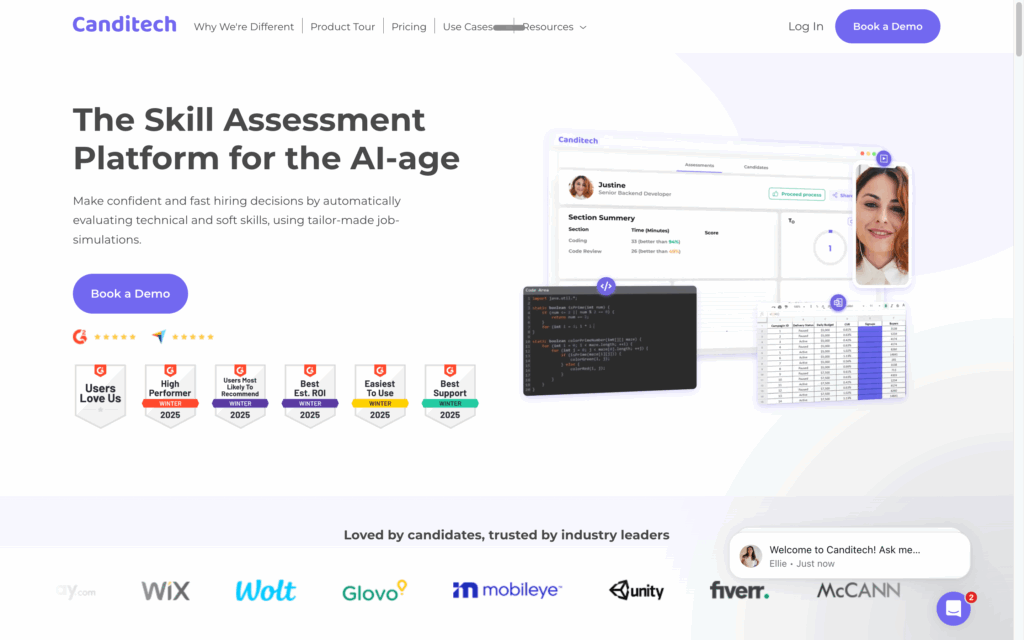
Canditech takes a skills-first approach to technical hiring by combining job-simulation assessments with video interviews, using AI to score candidates on both hard technical competencies and soft skills like communication and problem-solving. The platform offers over 500 pre-built tests covering programming languages, data science, DevOps, and non-technical functions, while also enabling companies to create custom assessments using AI.
What sets Canditech apart is its focus on validating what candidates can actually do rather than what they claim on resumes the assessments simulate real job tasks that reveal practical capability. With built-in ChatGPT detection and anti-cheating measures, Canditech ensures assessment integrity, addressing a major concern as AI tools become ubiquitous. The platform’s affordability starting at ₹3,800/month makes sophisticated skills testing accessible to startups and small teams who can’t afford enterprise assessment tools.
Standout Features
- AI assessment builder: Generate tests from job descriptions instantly
- 500+ pre-built tests: Covering technical roles (programming, data, DevOps) and non-technical functions
- Video interview integration: One platform for testing and interviews
- ChatGPT detection: Anti-cheating measures for assessment integrity
- Real-time candidate feedback: Transparency builds trust in the process
Pros and Cons
Pros: ✅ Comprehensive skills evaluation beyond resume claims
✅ Affordable pricing for startups and small teams
✅ Strong anti-cheating features ensure assessment validity
✅ Works for both technical and non-technical roles
Cons: ⚠️ ATS integration only available on higher-tier plans
⚠️ Annual commitment required for most plans
⚠️ Limited candidate sourcing capabilities compared to all-in-one platforms
Pricing
From $45/month (billed annually). Higher tiers add ATS integrations and advanced features.
6) Pinpoint
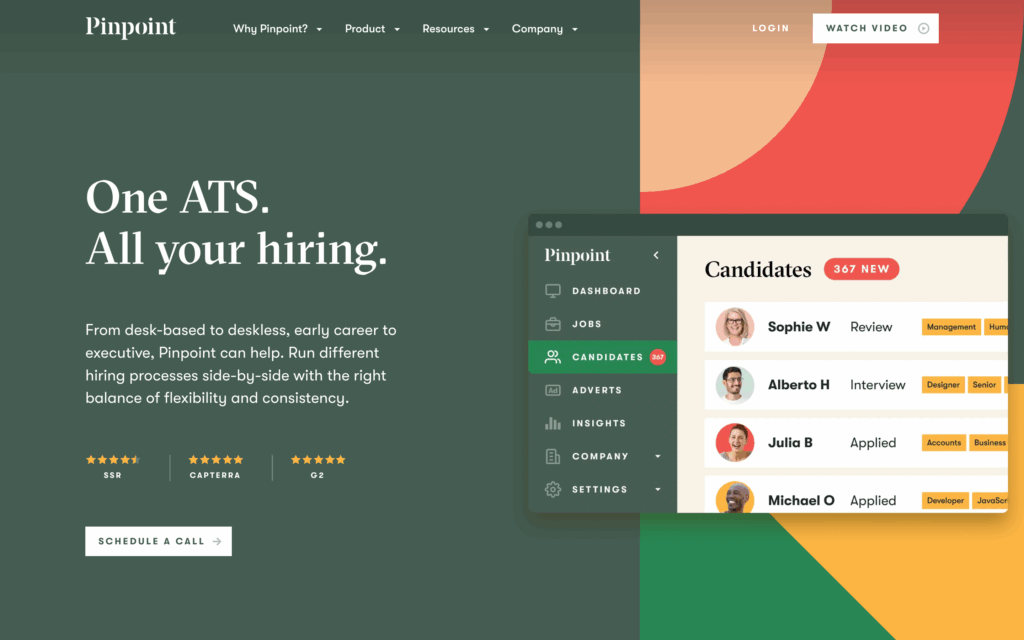
Best for: Automated screening and candidate experience
Starting Price: Custom | Free Trial: Demo available
Overview
Pinpoint positions itself as a candidate-experience-first ATS that happens to include powerful AI screening capabilities, rather than an AI tool with recruiting features bolted on. The platform focuses on creating streamlined, intuitive hiring experiences that reflect well on employer brand while automating the tedious parts of screening and evaluation.
Pinpoint’s AI resume parsing goes beyond simple keyword extraction to understand context, identify relevant skills, and score candidates automatically against job requirements. The platform emphasizes workflow automation, allowing recruiters to set up triggers that move candidates through stages, send communications, or notify team members based on specific actions or status changes. With a candidate portal that provides transparency into application status and GDPR-compliant data handling, Pinpoint appeals to companies who view recruiting as a two-way evaluation process where candidate perception matters.
Standout Features
- AI resume parsing: Extracts structured data and scores candidates automatically
- Automated workflows: Trigger actions based on candidate status changes
- Collaborative hiring: Tools for feedback collection and team decision-making
- Candidate portal: Self-service interface for applicants to track status
- Compliance features: GDPR and data privacy controls
Pros and Cons
Pros: ✅ Strong focus on candidate experience
✅ Flexible workflow automation
✅ Good balance of AI and human oversight
Cons: ⚠️ Less differentiation in crowded ATS market
⚠️ AI features not as advanced as specialized platforms
⚠️ Custom pricing lacks transparency
Pricing
Custom pricing based on company size and needs. Contact for demo.
7) SeekOut
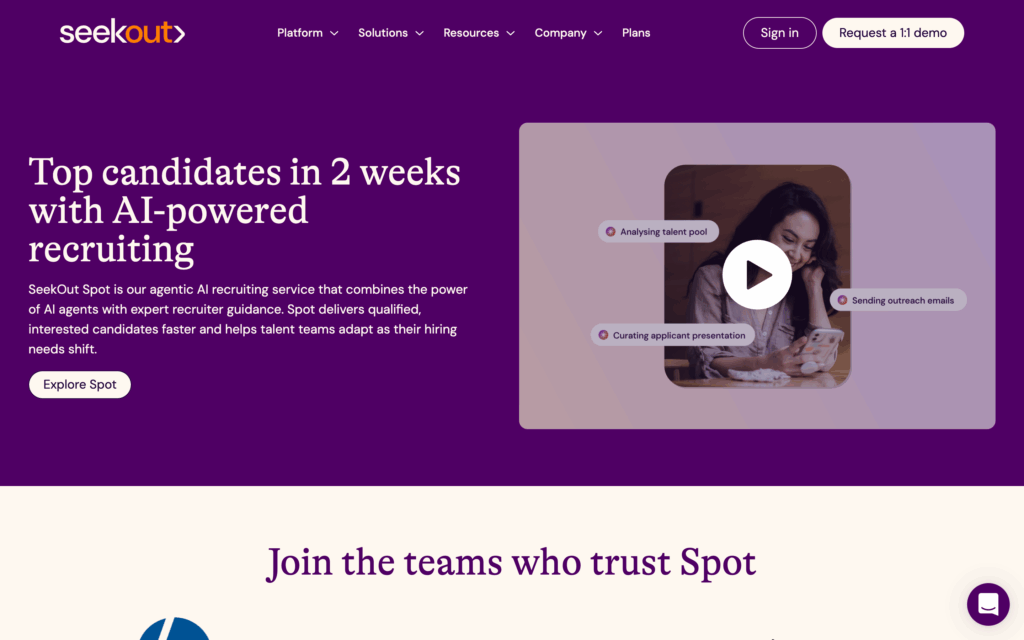
Best for: Sourcing hard-to-find talent and diversity hiring
Starting Price: Custom | Free Trial: 14 days
Overview
SeekOut is a specialized sourcing platform that leverages AI to discover passive candidates across a database of 330+ million professional profiles, with particular strength in identifying underrepresented talent for diversity hiring initiatives. Unlike platforms that wait for candidates to apply, SeekOut proactively finds people who aren’t actively job hunting but whose skills match your requirements.
The platform uses advanced AI algorithms to search across LinkedIn, GitHub, public professional profiles, and proprietary databases, surfacing candidates that traditional job postings would never reach. SeekOut’s AI-powered diversity sourcing filters help companies find candidates from underrepresented backgrounds without relying on demographic indicators that could introduce bias. The Chrome extension allows recruiters to source directly while browsing professional networks, and the talent mapping features provide competitive intelligence on where skilled professionals currently work, enabling strategic poaching.
Standout Features
- Massive candidate database: 330M+ profiles including underrepresented talent
- AI-powered diversity sourcing: Identifies candidates from diverse backgrounds
- Chrome extension: Source directly from LinkedIn and other platforms
- Talent mapping: Competitive intelligence on where skilled professionals work
- Automated outreach sequences: Personalized at scale
Pros and Cons
Pros: ✅ Exceptional for hard-to-find specialized talent
✅ Strong diversity sourcing capabilities
✅ Comprehensive candidate database
Cons: ⚠️ Focused on sourcing, not full hiring workflow
⚠️ Higher learning curve for advanced features
⚠️ Premium pricing puts it out of reach for many startups
Pricing
Custom pricing based on team size and usage. 14-day trial available. Contact for quote.
8) Gem
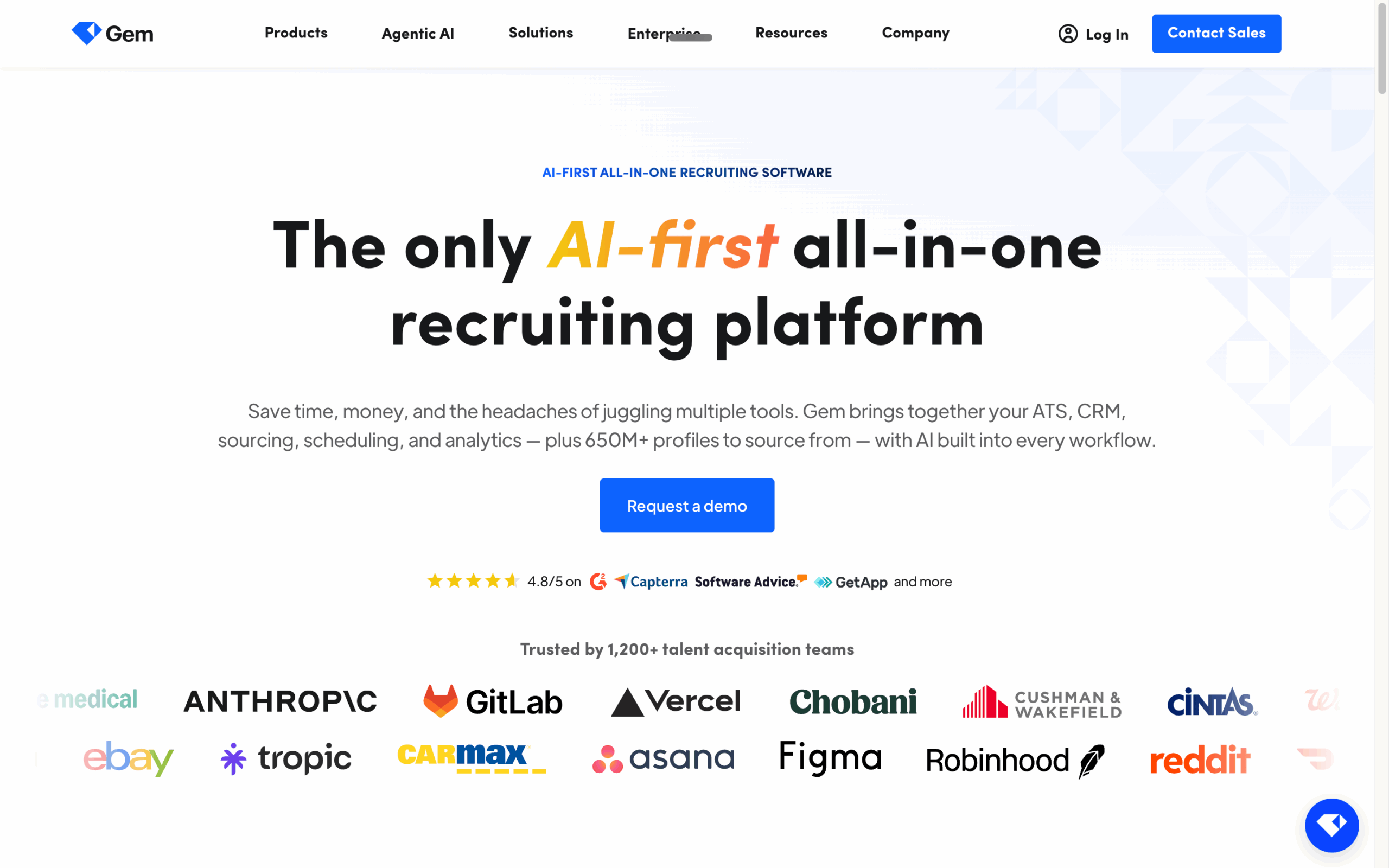
Best for: Multi-platform candidate engagement and CRM
Starting Price: Custom | Free Trial: Demo available
Overview
Gem functions as a recruiting CRM rather than a traditional ATS, focusing on building and nurturing long-term relationships with potential candidates across multiple touchpoints and platforms. The AI-powered system excels at personalized outreach at scale, managing email sequences that adapt based on engagement patterns, and tracking relationship warmth over time.
Gem integrates with LinkedIn, GitHub, and other professional platforms to create unified candidate profiles that combine sourcing data, interaction history, and engagement metrics in one place. The platform is built for relationship-driven hiring where companies maintain talent pipelines of passive candidates for months or years before roles open, making it particularly valuable for companies with dedicated sourcing teams or recruiters focused on building networks in competitive specialties. The shared talent pools enable team collaboration, preventing duplicate outreach and enabling coordinated recruiting strategies.
Standout Features
- AI outreach automation: Personalized email sequences that adapt based on engagement
- Multi-channel sourcing: Integrates LinkedIn, GitHub, and other professional platforms
- Pipeline analytics: Track engagement and conversion metrics
- Team collaboration: Shared talent pools and coordinated outreach
- CRM functionality: Nurture passive candidates for future opportunities
Pros and Cons
Pros: ✅ Excellent for building long-term talent pipelines
✅ Strong personalization in automated outreach
✅ Good for companies with dedicated sourcing teams
Cons: ⚠️ More focused on sourcing than end-to-end hiring
⚠️ Requires integration with separate ATS
⚠️ Best suited for larger recruiting teams
Pricing
Custom pricing based on team size and features. Contact for demo.
9) Fetcher
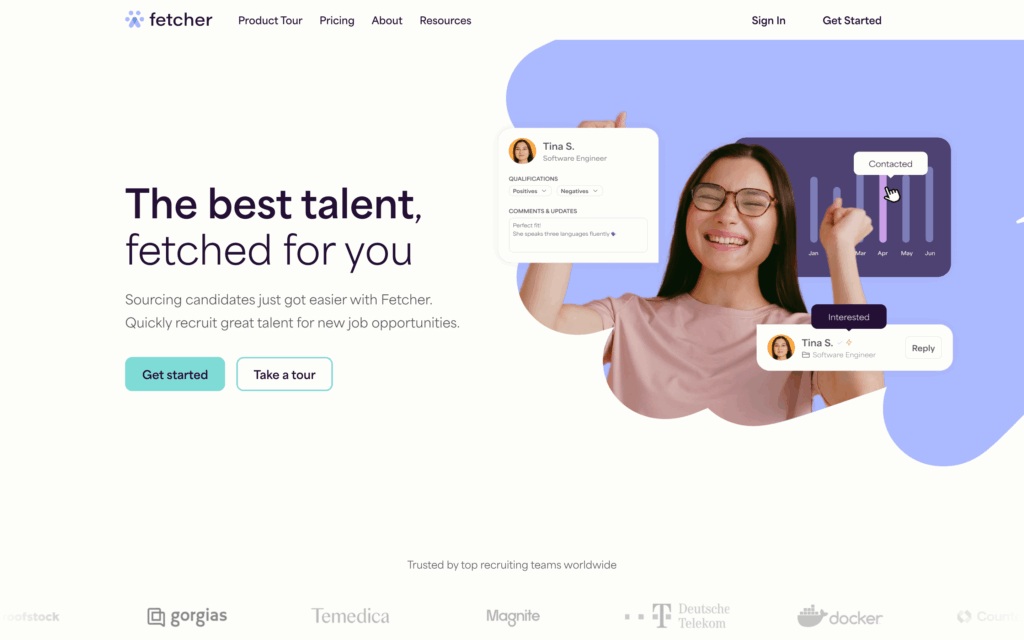
Best for: Automated sourcing and outreach
Starting Price: $549/user/month | Free Trial: Demo
Overview
Fetcher takes a unique hybrid approach to candidate sourcing by combining AI discovery algorithms with human research validation to deliver curated candidate pipelines. The platform essentially functions as an outsourced sourcing team, automatically finding candidates who match your criteria across multiple sources, then having human researchers validate the AI’s recommendations before delivering shortlists to your recruiting team.
Fetcher manages the entire outreach campaign, sending personalized messages, conducting A/B tests on messaging, and tracking engagement all while integrating seamlessly with major ATS platforms to push qualified candidates directly into your hiring workflow. The platform includes diversity filters to help companies target underrepresented groups systematically. For companies lacking dedicated sourcers or struggling to fill specialized roles where qualified candidates are scarce, Fetcher provides scalable access to sourcing expertise without expanding headcount, though at a premium price point.
Standout Features
- AI sourcing engine: Discovers candidates matching your criteria across multiple sources
- Human-AI hybrid: Researchers validate AI recommendations for quality
- Automated outreach campaigns: Personalized at scale with A/B testing
- Integration with major ATS: Seamlessly push candidates to your hiring workflow
- Diversity filters: Target underrepresented groups
Pros and Cons
Pros: ✅ High-quality sourcing through human-AI collaboration
✅ Saves massive time on candidate discovery
✅ Good for specialized or competitive roles
Cons: ⚠️ Expensive at $549/user/month
⚠️ Doesn’t include ATS functionality
⚠️ Overkill for companies with adequate applicant flow
Pricing
$549 per user per month. Custom enterprise pricing available.
10) Manatal
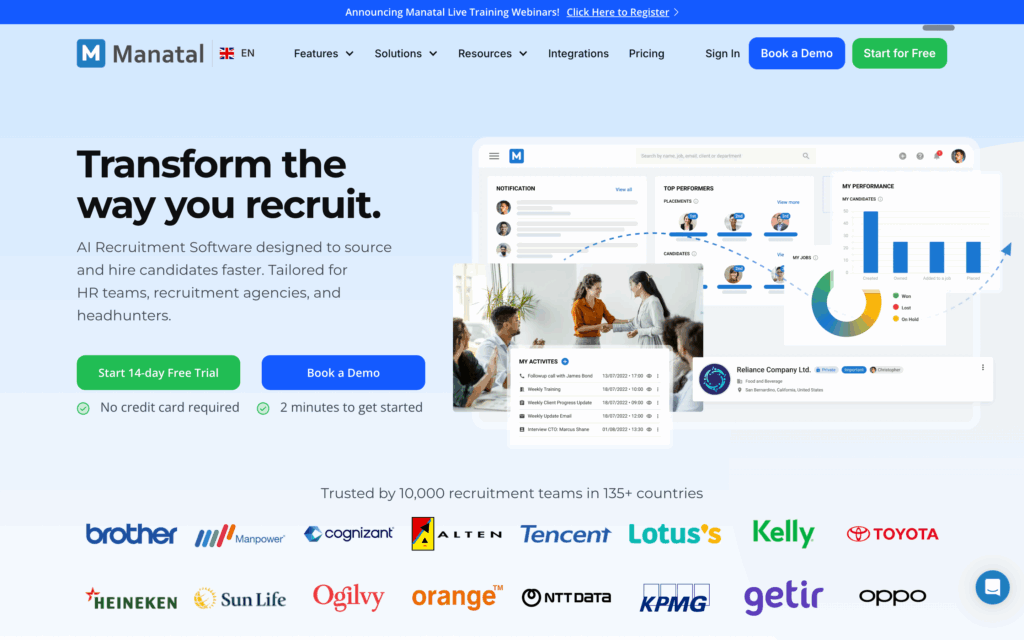
Best for: Budget-conscious teams needing customizable pipelines
Starting Price: $15/user/month | Free Trial: 14 days
Overview
Manatal delivers impressive ATS functionality at an exceptionally accessible price point, making sophisticated recruiting tools available to bootstrapped startups and small HR teams with limited budgets. The AI-powered platform includes candidate enrichment that automatically pulls additional information from social media profiles to create comprehensive candidate views, social media integration for multi-channel sourcing, and highly customizable pipelines that adapt to different role types and hiring workflows.
At ₹1,250/user/month for the entry tier, Manatal costs a fraction of competitors while still offering AI candidate scoring, job board posting to multiple sites, and a Chrome extension for sourcing candidates while browsing LinkedIn. The platform’s intuitive interface requires minimal training, allowing non-technical users to configure workflows through drag-and-drop rather than complex settings, making it particularly appealing for startups where founders or operations managers are handling recruiting alongside other responsibilities.
Standout Features
- AI enrichment: Automatically pulls candidate information from social media profiles
- Customizable pipelines: Configure stages and workflows for different roles
- Job board posting: Distribute to multiple boards
- Candidate scoring: AI ranks applicants by fit
- Chrome extension: Source candidates while browsing LinkedIn
Pros and Cons
Pros: ✅ Extremely affordable starting at $15/user/month
✅ Good feature set for the price
✅ Fast setup and intuitive interface
Cons: ⚠️ AI capabilities less sophisticated than premium platforms
⚠️ Limited advanced features compared to enterprise solutions
⚠️ Some users report occasional bugs
Pricing
Starting at $15/user/month. Professional plan at $55/user/month. Enterprise custom pricing.
11) Boon
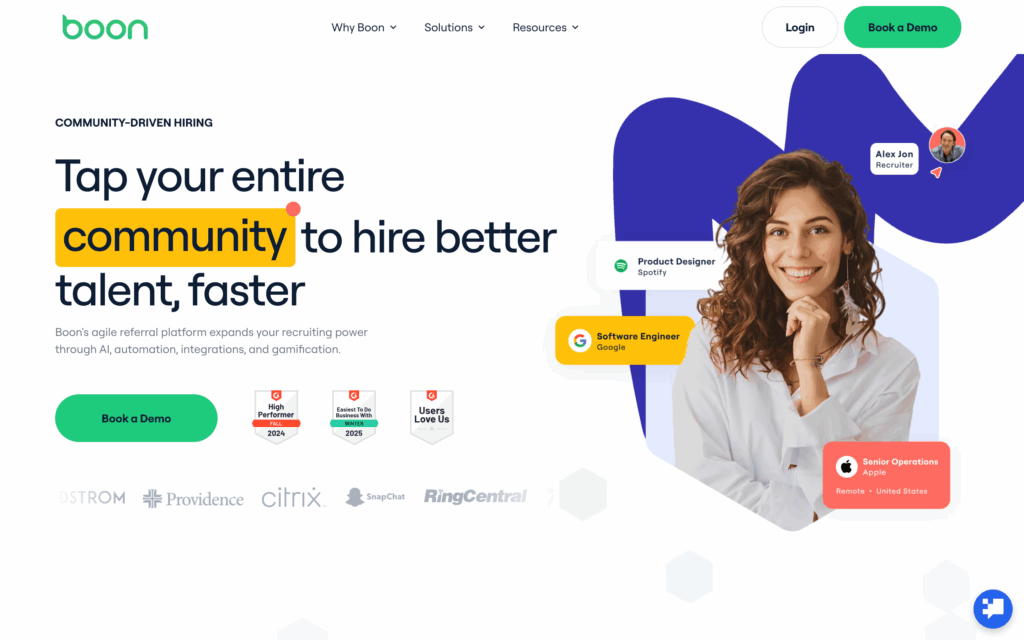
Best for: Employee referral programs
Starting Price: Custom | Free Trial: Demo
Overview
Boon specializes in leveraging AI to power employee referral programs, transforming what’s often a neglected hiring channel into a systematic source of high-quality candidates. The platform analyzes employee networks to identify connections who match open roles, then makes intelligent referral suggestions to employees most likely to know relevant candidates. Boon gamifies the referral process through leaderboards, rewards, and recognition to drive participation beyond one-time referral bonuses.
Employees can easily share job openings across their social networks through integrated sharing tools, and the platform tracks which employees generate quality hires over time, helping companies identify their best talent scouts. By integrating with existing ATS platforms, Boon adds referral program management without replacing recruiting infrastructure. For companies where cultural fit matters significantly and employee networks contain valuable talent, Boon makes it easy to tap into these connections systematically rather than relying on occasional ad-hoc referrals.
Standout Features
- AI referral matching: Analyzes employee networks to suggest relevant candidates
- Gamification: Leaderboards and rewards drive participation
- Social sharing: Easy tools for employees to promote openings
- Referral tracking: Monitor which employees generate quality hires
- Integration: Works with existing ATS platforms
Pros and Cons
Pros: ✅ Taps into powerful referral channel
✅ Engages employees in hiring process
✅ Quality hires through trusted networks
Cons: ⚠️ Narrow focus on one hiring channel
⚠️ Requires critical mass of employees to be effective
⚠️ Supplement to, not replacement for, other sourcing
Pricing
Custom pricing based on company size. Contact for demo.
12) Recruit CRM
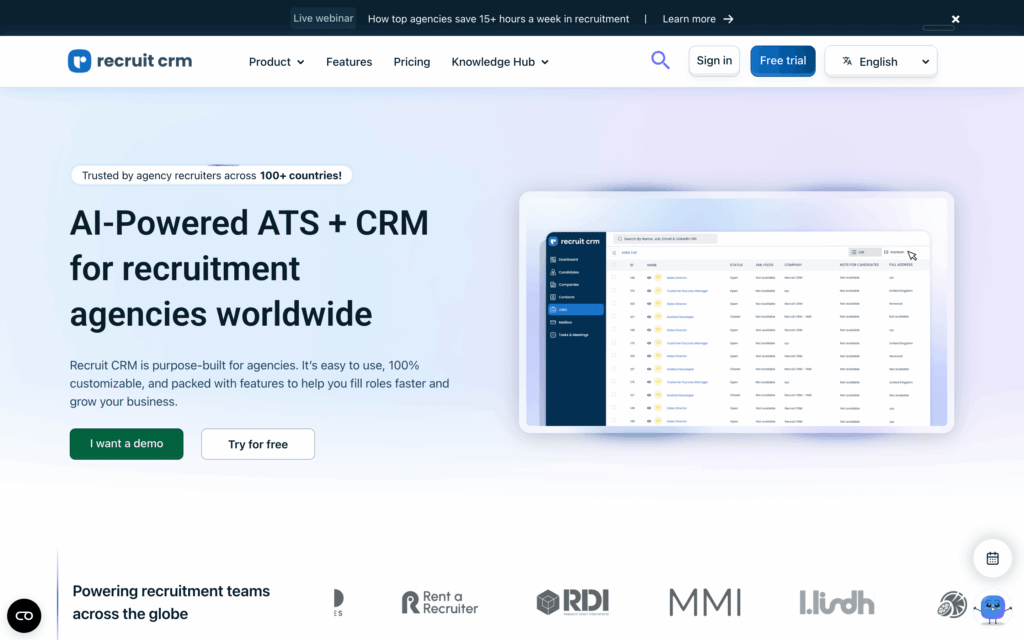
Best for: Recruitment agencies needing email sequencing
Starting Price: $84/user/month | Free Trial: Yes
Overview
Recruit CRM is purpose-built for staffing agencies and recruiting firms rather than in-house corporate recruiting teams, combining ATS and CRM functionality with powerful AI-driven email automation for managing both candidate and client relationships. The dual pipeline approach recognizes that agencies juggle two distinct sales processes placing candidates with clients and attracting candidates to represent.
The AI email automation creates personalized nurture sequences for both sides, keeping candidates engaged between placements and clients informed about suitable talent. With agency-specific reporting that tracks placements, billings, and commission structures, Recruit CRM understands the business model differences between agency and corporate recruiting.
The platform is highly customizable to accommodate different industries and placement specializations, from executive search to temp staffing. The Chrome extension enables sourcing candidates from LinkedIn while the reporting focuses on metrics agencies actually care about fill rates, time-to-placement, client satisfaction, and revenue per recruiter.
Standout Features
- AI email automation: Personalized sequences for candidate nurturing
- Dual pipeline: Manage both candidates and client relationships
- Chrome extension: Source candidates from LinkedIn
- Reporting: Agency-focused metrics and placement tracking
- Customizable: Configure for different industries and specializations
Pros and Cons
Pros: ✅ Built specifically for agencies and recruiting firms
✅ Strong email automation capabilities
✅ Good reporting for tracking placements
Cons: ⚠️ Overkill for in-house corporate recruiting
⚠️ Learning curve for advanced features
⚠️ Interface could be more modern
Pricing
$84/user/month for professional plan. Higher tiers add advanced features.
13) Checkr
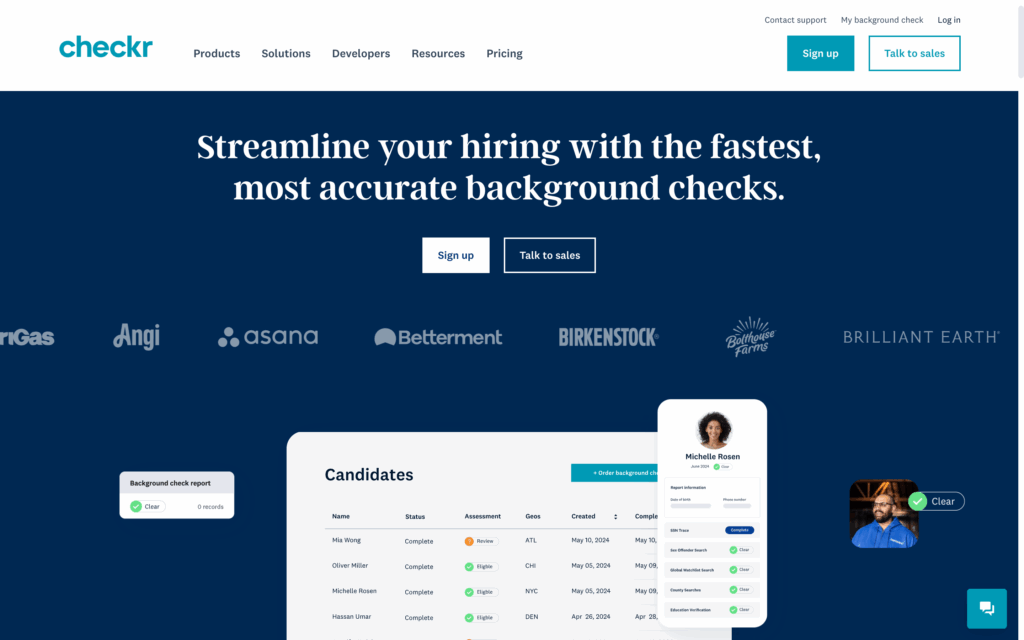
Best for: Background screening and compliance
Starting Price: $29.99/check | Free Trial: No
Overview
Checkr is the industry leader in AI-powered background screening, focusing on one critical final stage of the hiring process rather than attempting to be a full recruiting platform. The company uses AI to ensure compliance with FCRA regulations and local hiring laws that vary significantly across jurisdictions, automatically adjusting what can be reported based on where the candidate and employer are located.
Most background checks complete within 24-48 hours, significantly faster than traditional screening services that often take a week or more. Checkr offers comprehensive screening packages covering criminal records, employment verification, education verification, motor vehicle records, and more all configurable based on role requirements and company policies. The platform integrates via API with major ATS platforms, allowing automated triggering of background checks when candidates reach specific hiring stages. With straightforward pay-per-check pricing starting at $29.99, companies only pay for candidates they actually screen rather than maintaining subscription overhead.
Standout Features
- AI compliance checks: Ensures adherence to FCRA and local regulations
- Fast turnaround: Most checks complete in 24-48 hours
- Automated workflows: Trigger checks based on hiring stage
- Comprehensive reports: Criminal, employment, education, and more
- API integration: Connect with major ATS platforms
Pros and Cons
Pros: ✅ Industry leader in background screening
✅ Fast and reliable service
✅ Strong compliance features
Cons: ⚠️ Not a recruiting platform focused on one stage
⚠️ Costs add up with high-volume hiring
⚠️ Requires separate ATS integration
Pricing
Pay-per-check starting at $29.99. Volume discounts available.
14) iCIMS
Best for: Large enterprises and global hiring
Starting Price: Custom | Free Trial: Demo
Overview
iCIMS is an enterprise-grade talent acquisition suite built for large organizations hiring across multiple countries, languages, and regulatory environments. The platform’s AI capabilities include multilingual screening that can evaluate candidates in dozens of languages, ensuring global companies don’t miss qualified talent due to language barriers.
iCIMS handles the complex compliance requirements that multinational corporations face, navigating different employment laws, data privacy regulations like GDPR, and reporting requirements across jurisdictions. The platform includes built-in video interviewing for both asynchronous recorded interviews and live video calls, advanced analytics with predictive insights on hiring trends, and extensive integrations with enterprise HR systems like Workday and SAP SuccessFactors. With robust security features, audit trails, and role-based permissions, iCIMS meets the governance standards that large organizations require. The platform is designed to coordinate hiring across many departments and locations while maintaining consistency and compliance.
Standout Features
- AI multilingual screening: Support for diverse candidate pools
- Global compliance: Navigate regulations across jurisdictions
- Video interviewing: Built-in asynchronous and live interviews
- Advanced analytics: Enterprise reporting and predictive insights
- Extensive integrations: Connect with enterprise HR systems
Pros and Cons
Pros: ✅ Comprehensive enterprise features
✅ Strong global hiring capabilities
✅ Robust compliance and security
Cons: ⚠️ Complex implementation requiring IT resources
⚠️ Expensive for small and mid-market companies
⚠️ Steeper learning curve
Pricing
Custom enterprise pricing. Contact for detailed quote.
15) Jobvite
Best for: Data-driven hiring strategy optimization
Starting Price: Custom | Free Trial: Demo
Overview
Jobvite emphasizes analytics and strategic hiring insights, using AI to identify patterns in successful hires and optimize recruiting strategies over time rather than just facilitating tactical hiring execution. The platform’s AI analytics engine examines historical hiring data to surface predictive insights about which sourcing channels produce the best candidates, which screening criteria correlate with long-term success, and where bottlenecks slow down your hiring process.
Jobvite includes strong social recruiting capabilities that leverage social networks for candidate discovery, built-in employee referral program management with tracking and incentives, and talent network features for building pools of engaged passive candidates who can be activated when relevant roles open. The comprehensive reporting dashboards track metrics from source-to-hire, providing visibility into recruiting ROI and effectiveness that helps talent leaders make data-informed decisions about where to invest resources. For organizations treating recruiting as a strategic function requiring continuous improvement, Jobvite provides the analytics foundation.
Standout Features
- AI analytics: Predictive insights on hiring success factors
- Social recruiting: Leverage social networks for candidate sourcing
- Employee referrals: Built-in referral program management
- Talent network: Build pools of engaged passive candidates
- Reporting: Comprehensive hiring metrics and dashboards
Pros and Cons
Pros: ✅ Strong focus on strategic analytics
✅ Good for companies prioritizing data-driven decisions
✅ Comprehensive feature set
Cons: ⚠️ Complex platform with many features to learn
⚠️ Best suited for larger teams with dedicated TA resources
⚠️ Custom pricing lacks transparency
Pricing
Custom pricing based on company size and needs. Contact for demo.
AI Recruiting Software by Use Case
Choosing the right platform depends heavily on your specific hiring needs. Let’s break down the best options for common scenarios.
Best for High-Volume Hiring
Top Picks: JusRecruit, Humanly, Workable
When you’re hiring dozens or hundreds of similar roles, speed and consistency become paramount. These platforms excel at processing large applicant volumes without sacrificing quality:
JusRecruit leads this category through Saina’s ability to interview hundreds of candidates in parallel. Where traditional phone screens would take weeks or months for high-volume hiring, Saina can conduct structured interviews with 200+ candidates in 48 hours. The pre-vetted candidate pool provides immediate access to qualified shortlists when you need to fill multiple positions simultaneously.
Humanly excels at candidate engagement at scale, using chatbots to handle repetitive screening questions, send automated updates, and keep large candidate pools warm throughout the process.
Workable offers strong pipeline management for tracking large volumes, with bulk actions allowing recruiters to move 50 candidates to the next stage with one click.
Key features needed for high-volume:
- Automated screening that maintains quality standards
- Bulk actions for efficient pipeline management
- Quick-glance scorecards for rapid candidate evaluation
- SMS/text recruiting for reaching hourly workers
Use case example: A retail company hiring for 100 store associate positions across 20 locations used JusRecruit’s AI interviews to screen 500+ applicants in 48 hours. They identified 120 qualified candidates and scheduled final interviews without any recruiter conducting phone screens, filling all positions in under three weeks.
Best for Startups
Top Picks: JusRecruit, Manatal, Canditech
Startups need platforms that deliver immediate value without lengthy implementations or enterprise-level budgets:
JusRecruit is purpose-built for startups needing all-in-one affordability. There’s no need for multiple disconnected tools, complex integrations, or dedicated implementation teams. Founders without recruiting experience can set up Saina interviews in 15 minutes and start evaluating candidates the same day.
Manatal offers a compelling entry point at $15/user/month with solid core functionality for budget-conscious teams.
Canditech provides excellent skills-based hiring for early-stage tech teams needing to validate technical capabilities.
Startup-specific needs addressed:
- Zero implementation time (day-one value like JusRecruit provides)
- Transparent, predictable pricing without enterprise minimums
- No long-term contracts or commitments
- Generalist-friendly interfaces that non-recruiters can use
Use case example: A SaaS startup with no dedicated recruiter used JusRecruit to hire their first 10 employees in 90 days. The CEO configured Saina interviews in 15 minutes, posted to job boards, and let AI handle first-round screens while focusing on product development. The startup filled engineering, sales, and customer success roles without ever conducting traditional phone screens.
Automate your first round intervieww
We understand your struggles with first round interviews which are a hit and miss. .
Best for Enterprise
Top Picks: Greenhouse, Workable, iCIMS
Large organizations need platforms that handle complexity, compliance, and coordination across multiple teams and locations:
Greenhouse provides mature compliance features, DEI analytics, and structured hiring frameworks that enterprises require for consistent, defensible hiring practices across departments.
Workable scales effectively for distributed teams with strong permission controls and reporting.
iCIMS excels at global, multi-language support for truly international hiring.
Enterprise requirements:
- SSO and enterprise-grade security
- Multi-region, multi-language support
- Complex approval workflows
- Advanced compliance (EEO, OFCCP reporting)
- White-labeling capabilities
Note: While JusRecruit currently targets startups and mid-market companies, enterprise-focused features including SSO, advanced permissions, and API access are in active development for companies ready to scale.
Best for Diversity Hiring
Top Picks: Greenhouse, SeekOut, JusRecruit
Improving diversity requires both conscious sourcing strategies and bias reduction in evaluation:
Greenhouse leads with resume anonymization, diversity analytics throughout the pipeline, and structured hiring frameworks that reduce unconscious bias.
SeekOut provides access to 330M+ underrepresented candidate profiles with powerful diversity sourcing filters.
JusRecruit addresses bias through standardized evaluation. Saina conducts the same structured interview with every candidate, applying identical criteria and evaluation rubrics. This consistency eliminates many sources of unconscious bias that creep into traditional phone screens where different recruiters use different questions and standards.
DEI-focused features:
- Blind resume screening removing names and demographic indicators
- Structured interview questions ensuring fair evaluation
- Diverse candidate sourcing tools
- DEI pipeline analytics tracking representation at each stage
- Bias detection alerts
Use case example: A tech company improved female engineering hires from 15% to 35% of new hires using JusRecruit’s standardized AI interviews. By evaluating all candidates against identical technical and communication criteria, the company eliminated inconsistency in early-stage screening that had previously disadvantaged some candidates.
How to Choose the Right AI Recruiting Platform
Not all AI recruiting platforms are created equal, and the “best” choice depends heavily on your specific circumstances. Here’s a decision framework to identify the optimal fit.
1. Define Your Primary Pain Point
Start by identifying your biggest hiring challenge:
“We get too many applications to screen manually” → JusRecruit, Workable
These platforms excel at automated screening that separates signal from noise.
“Scheduling interviews wastes hours each week” → JusRecruit (Saina), Humanly
Automated interview scheduling or AI-conducted interviews eliminate coordination time.
“You struggle to source passive candidates” → SeekOut, Fetcher
Specialized sourcing platforms discover candidates not actively applying.
“Our Team needs better skills assessments” → Canditech, JusRecruit
Skills testing and AI interviews validate capabilities beyond resume claims.
“Hiring is too slow and we lose candidates” → JusRecruit (fastest time-to-first-interview)
Platforms offering immediate AI screening and interviews compress timelines dramatically.
2. Assess Your Team Size & Budget
Different platforms are optimized for different organizational scales:
| Company Stage | Budget Range | Best Platforms | Why |
|---|---|---|---|
| Pre-seed/Seed Startup (1-10 employees) | <$500/mo | JusRecruit, Manatal | Affordable, founder-friendly, fast setup |
| Series A/B (10-50 employees) | $500-$2K/mo | JusRecruit, Workable, Canditech | Scalable features, still lean operations |
| Growth Stage (50-200 employees) | $2K-$10K/mo | JusRecruit Enterprise, Greenhouse, Gem | Advanced features, multi-team coordination |
| Enterprise (200+ employees) | $10K+/mo | Greenhouse, iCIMS, Workable | Compliance, global support, complex workflows |
💡 Pro tip: JusRecruit offers exceptional value across all stages because of its all-in-one pricing model (ATS + AI interviews + candidate pool). You’re not paying separately for sourcing, screening, interviewing, and tracking tools.
3. Evaluate AI Maturity Needed
Consider how sophisticated your AI requirements are:
Basic AI: Resume parsing and keyword matching → Most modern ATS platforms offer this
Intermediate AI: Candidate scoring and chatbot screening → Workable, Humanly provide solid middle-tier AI
Advanced AI: Conversational interviews and predictive analytics → JusRecruit (Saina), Greenhouse offer cutting-edge capabilities
Critical question: “Do you need AI to fully replace first-round phone screens?” If yes, JusRecruit is the only platform with true conversational interview automation via Saina. Other chatbots conduct rigid Q&A, but Saina engages in natural dialogue that adapts based on candidate responses.
4. Check Integration Requirements
Ensure the platform works with your existing tools:
Must-have integrations:
- Existing ATS (if you’re keeping it and adding AI capabilities)
- HRIS systems (BambooHR, Rippling, Workday)
- Communication tools (Slack, Teams, Gmail)
- Background check providers (Checkr, Sterling)
- Calendar systems (Google Calendar, Outlook)
JusRecruit integrates with major platforms and offers API access for custom connections on enterprise plans.
5. Consider Implementation Timeline
Time-to-value varies dramatically:
Fast (1-7 days): JusRecruit, Manatal
Create account, configure jobs, start hiring immediately
Medium (2-4 weeks): Workable, Gem
Requires some configuration and team training
Long (1-3 months): Greenhouse, iCIMS
Enterprise implementations with IT involvement and extensive customization
If you need to hire immediately: Choose platforms offering day-one value like JusRecruit, which requires no complex setup simply create a job, enable AI vetting, configure Saina interviews, and start reviewing qualified candidates within hours.
6. Test with Free Trials
Never commit without hands-on experience:
Platforms with trials:
- ✅ JusRecruit: 14 days (full access, no credit card required)
- ✅ Workable: 15 days
- ✅ Manatal: 14 days
- ✅ Canditech: Yes
- ✅ SeekOut: 14 days
Testing checklist:
- Set up a real job posting
- Test AI screening on sample resumes
- Try interview or assessment features
- Review candidate experience (apply yourself)
- Check reporting and analytics
- Test mobile app functionality
- Evaluate support responsiveness
Implementation Guide: Rolling Out AI Recruiting
Even the best AI recruiting software fails without proper implementation. Follow this battle-tested roadmap to ensure smooth adoption, stakeholder buy-in, and measurable ROI within 90 days.
30-60-90 Day Implementation Plan
Days 1-30: Foundation & Setup
1 Week: Platform Setup + Team Training
- Complete vendor onboarding sessions
- Set up integrations (HRIS, email, calendar)
- Import job templates and role definitions
- Configure user permissions and workflows
- JusRecruit specific: Set up Saina interview questions for 2-3 pilot roles
2 Week: Create Scoring Rubrics
- Define must-have vs. nice-to-have criteria for each role
- Build candidate scoring frameworks
- With JusRecruit: Train Saina on role-specific evaluation criteria
- Align hiring managers on what “qualified” actually means
3 Week: Pilot with 1-2 Roles
- Choose low-risk, high-volume roles for testing (e.g., entry-level positions)
- Run AI screening alongside manual screening for comparison
- Collect feedback from recruiters and hiring managers
- Have hiring managers review AI scorecards and recommendations
4 Week: Review & Adjust
- Analyze pilot results (time saved, candidate quality, accuracy)
- Refine AI settings based on false positives/negatives
- Document early wins to share with leadership
- Prepare for broader rollout across more roles
Success Metrics (30-day):
- ✅ Platform fully configured and operational
- ✅ 2-3 roles actively using AI screening
- ✅ 30%+ time savings documented compared to baseline
- ✅ Team trained and comfortable with interface
Days 31-60: Scale & Optimize
5-6 Week: Expand to All Active Roles
- Migrate all open positions to new platform
- Enable AI screening for all new applicants
- With JusRecruit: Enable Saina interviews for suitable roles (typically roles with >10 applicants)
- Train additional team members and hiring managers
7 Week: Candidate Experience Audit
- Survey candidates on their application experience
- Check email open rates and response rates
- Test mobile application flow
- Ensure AI interactions feel helpful, not robotic
8 Week: Integration Optimization
- Fine-tune job board posting strategy
- Set up automated workflows (status updates, reminders)
- Connect background check tools
- Integrate offer letter systems
Success Metrics (60-day):
- ✅ 100% of active roles using AI screening
- ✅ 50%+ reduction in time-to-first-interview
- ✅ Positive candidate Net Promoter Scores
- ✅ Hiring manager adoption rate >80%
Days 61-90: Measure & Improve
9-10 Week: Data Analysis
- Generate comprehensive ROI report (time saved, cost per hire, quality metrics)
- Identify remaining bottlenecks in hiring process
- Compare AI-sourced hires vs. traditional hires (retention, performance ratings)
11 Week: Advanced Feature Adoption
- Enable pre-vetted candidate pool access (if using JusRecruit)
- Set up automated nurture campaigns for passive candidates
- Implement predictive analytics (if available)
12 Week: Stakeholder Review
- Present results to leadership with concrete metrics
- Share success stories and case studies with broader team
- Plan for continuous improvement initiatives
- Set goals for next quarter
Success Metrics (90-day):
- ✅ 60%+ faster time-to-hire compared to pre-AI baseline
- ✅ 40%+ cost reduction per hire
- ✅ Measurable quality of hire improvements (retention, performance)
- ✅ Full team adoption and satisfaction
Common Pitfalls to Avoid
1. Skipping the Pilot Phase
❌ Mistake: Rolling out to all roles immediately without testing
✅ Fix: Test with 1-2 roles first, learn from the experience, then scale
Why it matters: Allows you to catch configuration issues and calibrate AI settings before they affect your entire pipeline. Early lessons learned prevent widespread problems.
2. Not Training Hiring Managers
❌ Mistake: Assuming AI scorecards are self-explanatory
✅ Fix: Invest 1 hour training hiring managers on interpreting AI recommendations and when to override
Why it matters: Hiring managers who don’t understand or trust AI scores will ignore them, negating the tool’s value. Proper training builds confidence in AI-assisted decisions.
3. Over-Automating Too Soon
❌ Mistake: Letting AI automatically reject candidates without human review
✅ Fix: Keep humans in the loop initially; AI should recommend, not decide unilaterally
With JusRecruit: Saina generates comprehensive scorecards, but recruiters and hiring managers always make the final call on who advances. This human oversight ensures quality and builds team trust in the system.
4. Ignoring Candidate Experience
❌ Mistake: Optimizing only for recruiter efficiency
✅ Fix: Test the candidate journey yourself; ensure AI interactions are respectful, clear, and professional
Warning sign: High drop-off rates in application or assessment stages often indicate poor candidate experience.
5. Not Measuring ROI
❌ Mistake: Implementing without establishing baseline metrics
✅ Fix: Document time-to-hire, cost-per-hire, and quality metrics BEFORE implementation
Why it matters: You need before/after data to prove ROI to leadership and secure continued investment in the platform.
Quality Metrics Improvement
Quality of Hire = (Job Performance + Retention Rate + Hiring Manager Satisfaction) / 3
Metrics to Track:
1. 90-Day Retention Rate
- Industry benchmark: 70-80%
- With AI recruiting (standardized evaluation): 85-90%
- Improvement driver: Better skills matching and cultural fit assessment upfront
2. Time to Productivity
- Traditional hiring: 60-90 days to full productivity
- With AI-vetted candidates: 45-60 days
- Why: Candidates are pre-qualified on key skills, requiring less remedial training
3. Hiring Manager Satisfaction Scores
- Measure on 1-10 scale quarterly
- Target: 8+ average rating
- JusRecruit advantage: Hiring managers appreciate receiving pre-screened, scorecard-backed candidates rather than unvetted applicants
4. Offer Acceptance Rate
- Industry average: 85%
- With strong AI recruiting processes: 90-95%
- Improvement driver: Faster processes reduce candidate drop-off; better matching increases enthusiasm
ROI Formula for Quality Improvements:
Future of AI in Recruiting (2025-2030)
AI recruiting is evolving rapidly. Understanding upcoming trends helps you choose platforms positioned for the future, not just today’s needs.
Emerging Technologies
1. Generative AI for Hyper-Personalization
The next wave of AI recruiting will leverage large language models to create truly personalized candidate experiences:
- Every outreach email uniquely crafted based on candidate background and interests
- Custom interview questions generated dynamically for each candidate
- Real-time conversation adjustments based on candidate responses and engagement levels
This represents a shift from “personalization at scale” to “unique experiences at scale.”
2. Predictive Success Modeling
AI will increasingly predict not just initial fit, but long-term success probability:
- Algorithms that forecast performance reviews 6-12 months post-hire
- Retention risk scoring before extending offers
- Career trajectory forecasting to identify high-potential candidates
Companies will make offers based on predicted outcomes rather than just qualifications.
3. Skills Intelligence Platforms
The future of recruiting moves from keyword matching to deep skills inference:
- AI that identifies transferable skills from seemingly unrelated industries
- Real-time skills taxonomy updates as the job market evolves
- Automatic detection of “adjacent skills” that predict quick learning ability
This enables hiring based on capability rather than just specific experience.
4. Voice & Sentiment Analysis
Deeper insights from conversational interviews:
- Emotion detection revealing genuine enthusiasm vs. rehearsed responses
- Communication pattern analysis for cultural fit indicators
- Confidence and authenticity scoring
Ethical consideration: Transparency and explicit candidate consent will be critical for adoption. Platforms that implement these features without clear disclosure will face backlash.
Platforms to watch: JusRecruit (expanding Saina’s capabilities), Eightfold.ai (skills intelligence), HireVue (video analysis)
Predicted Trends
Trend 1: AI Becomes Table Stakes
By 2027, an estimated 80%+ of companies will use some form of AI in recruiting. Non-AI platforms will be viewed as legacy technology, much like non-cloud software is today.
Implication: Choose platforms with strong AI roadmaps and frequent innovation cycles. Vendors releasing updates quarterly are more likely to stay current than those with annual release schedules.
Trend 2: Candidate Experience Differentiation
As AI becomes ubiquitous, the winners will be platforms that make automation invisible to candidates:
- AI that feels seamless and human-like, not robotic
- Transparency about when AI is being used and how decisions are made
- Human touchpoints at critical moments even in heavily automated processes
Winners: Platforms like JusRecruit that balance automation with human touch
Losers: Clunky chatbots that frustrate candidates and damage employer brand
Trend 3: Skills-First Hiring Dominance
Traditional credentials (degrees, company brand names) will matter less as skills validation improves:
- Demonstrated capabilities trump pedigree
- AI assessment tools become the primary screening mechanism
- Job descriptions rewritten as skills taxonomies rather than requirements lists
JusRecruit’s Saina interviews already embody this trend, evaluating what candidates can actually do rather than what their resume claims.
Trend 4: Global Talent Pool Expansion
AI breaks down traditional barriers to international hiring:
- Real-time translation enables interviews across languages
- Geographic boundaries dissolve for remote-friendly roles
- Skills-based matching finds the best person regardless of location
Opportunity: JusRecruit’s pre-vetted pool can scale globally as the candidate base expands internationally.
How to Prepare
1. Choose Adaptable Platforms
Prioritize vendors with frequent updates and demonstrated AI innovation:
- Red flag: Legacy systems with annual release cycles
- Green flag: Product-led companies like JusRecruit with rapid iteration
Ask vendors: “How often do you ship new features? What’s your AI roadmap?”
2. Build AI-Ready Processes
Prepare your organization for AI-augmented hiring:
- Standardize job requirements and interview rubrics now
- Document what “good” looks like (helps AI learn your preferences)
- Train hiring managers on AI-assisted decision-making
3. Stay Compliant
Monitor evolving AI hiring regulations:
- EU AI Act classifications for hiring algorithms
- NYC Local Law 144 bias audit requirements
- Emerging state-level legislation
Choose transparent platforms that can explain AI decisions and conduct regular bias audits.
4. Invest in Change Management
AI adoption is cultural, not just technological:
- Train recruiters to be “AI-augmented” rather than replaced
- Celebrate wins and share time savings metrics
- Address concerns about job security openly and honestly
Future-proof strategy: Partner with vendors like JusRecruit who demonstrate commitment to continuous AI innovation while maintaining ethical guardrails and transparency.
Frequently Asked Questions
1. Will AI recruiting software replace human recruiters?
No. AI handles repetitive, time-consuming tasks like resume screening, scheduling, and initial qualification questions. This frees recruiters to focus on high-value activities that require human judgment: building relationships with candidates, assessing cultural fit in nuanced ways, employer branding, and strategic hiring planning.
Think of it as “AI-augmented recruiting” rather than replacement. The best recruiters will be those who leverage AI tools effectively while maintaining the human touch that candidates value.
2. How accurate is AI at screening candidates?
Accuracy depends on the platform and configuration. Best-in-class systems like JusRecruit’s Saina achieve 85-90% accuracy when properly configured with clear job requirements and evaluation criteria.
However, AI should recommend rather than automatically reject candidates. Always keep humans in the loop for final decisions. The goal is to surface the best candidates more efficiently, not to achieve perfection.
3. Can AI recruiting reduce bias?
Yes, when designed properly. AI can reduce unconscious bias by:
- Standardizing evaluation criteria for all candidates
- Anonymizing resumes (removing names, photos, addresses)
- Focusing on skills and experience rather than demographic factors
However, AI can also perpetuate bias if trained on historically biased data. Choose platforms with transparent algorithms, regular bias audits, and controls that let you calibrate what “fit” means.
4. What’s the ROI timeline for AI recruiting software?
Most companies see positive ROI within 3-6 months, primarily from:
- Reduced recruiter hours (23 hours per hire → 2-3 hours)
- Lower agency fees (especially with pre-vetted pools like JusRecruit’s)
- Faster time-to-hire reducing vacancy costs
For detailed calculations, see the ROI Calculator section above.
5. How long does implementation take?
Implementation varies by platform:
- Fast (1-7 days): JusRecruit, Manatal
- Medium (2-4 weeks): Workable, Gem
- Long (1-3 months): Enterprise platforms like Greenhouse, iCIMS
JusRecruit is specifically designed for day-one value, create a job, enable AI vetting, configure Saina interviews, and start reviewing qualified candidates immediately.
6. Do candidates dislike AI in recruiting?
Mixed reactions. Candidates appreciate: ✅ Faster response times
✅ Transparent expectations
✅ 24/7 application availability
✅ Consistency in evaluation
They dislike: ❌ Impersonal “black box” rejections with no explanation
❌ Clunky chatbots with poor conversational ability
❌ No option to speak with a human at any stage
Best practice: Use AI for efficiency in early stages, but ensure human touchpoints at critical moments. With JusRecruit, Saina conducts initial interviews, but recruiters personally follow up with qualified candidates.
7. What if my team isn’t tech-savvy?
Choose user-friendly, no-code platforms like JusRecruit designed for non-technical users. Look for:
- Intuitive dashboards that don’t require training
- Drag-and-drop workflow builders
- Excellent onboarding and documentation
- Responsive customer support
Avoid: Platforms requiring API configurations or complex technical setup.
8. Can AI recruiting work for non-tech roles?
Absolutely. While AI recruiting started in tech, it now works effectively for:
- Sales & customer success
- Marketing & creative roles
- Operations & finance
- Healthcare & education
- Retail & hospitality
JusRecruit specifically: Saina can interview candidates for any role, not just engineering positions. The system adapts questions and evaluation criteria to whatever role you’re hiring for.
9. How do I ensure data privacy and compliance?
Choose platforms with:
- GDPR compliance (for European candidates)
- SOC 2 Type II certification
- Data encryption at rest and in transit
- Clear data retention and deletion policies
- Transparent information on how candidate data is used
Ask vendors directly about their security certifications and compliance framework
11. Can I try before I buy?
Yes. Many platforms offer:
Free trials: JusRecruit (14 days), Workable (15 days), Manatal (14 days)
Freemium plans: Some tools offer limited free versions
Demos: Most enterprise platforms offer guided demonstrations
AI Recruiting Glossary of Terms
AI recruiting introduces new terminology. Here are key terms to know when evaluating platforms.
ATS (Applicant Tracking System): Software that manages the recruiting and hiring process from job posting to offer letter. Modern ATS often include AI features for screening and matching.
Bias Auditing: Regular testing of AI algorithms to detect and mitigate discriminatory patterns in candidate evaluation, ensuring fair hiring practices.
Candidate Matching: AI algorithms that score how well a candidate’s skills, experience, and qualifications align with specific job requirements.
Candidate Scoring/Ranking: Assigning numeric scores to candidates based on job fit, allowing recruiters to prioritize top matches efficiently.
Chatbot (Recruiting): AI-powered conversational interface that answers candidate questions, schedules interviews, or conducts basic screening via text or voice.
Conversational AI: Advanced AI capable of conducting natural, two-way conversations with candidates (e.g., JusRecruit’s Saina interviewer), adapting based on responses rather than following rigid scripts.
Machine Learning (ML): AI technique where systems learn from data patterns to improve predictions over time without explicit programming, becoming more accurate with more data.
Natural Language Processing (NLP): AI’s ability to understand and interpret human language in resumes, job descriptions, and candidate conversations, going beyond simple keyword matching.
Predictive Analytics: Using historical data and AI to forecast future hiring outcomes such as candidate success probability, time-to-fill, or retention likelihood.
Pre-Vetted Candidate Pool: Database of candidates who have already completed assessments or interviews, ready for immediate consideration when relevant jobs open (JusRecruit feature).
Resume Parsing: AI automatically extracting structured data (skills, experience, education) from unstructured resume documents in various formats.
Skills-Based Hiring: Evaluating candidates primarily on demonstrated skills and competencies rather than credentials like degrees, company brand names, or years of experience.
Structured Interview: Standardized interview with consistent questions and scoring criteria for all candidates, reducing bias and improving AI training data quality.
Time-to-Fill: Metric measuring days from job opening creation to accepted offer. AI recruiting typically reduces this by 30-50%.
Time-to-First-Interview: Days from application submission to first interview. JusRecruit’s Saina can reduce this to hours rather than weeks through automated screening.
Video Interview Intelligence: AI analysis of recorded video interviews to assess communication skills, enthusiasm, and other indicators (requires careful ethical implementation).
Get Started with JusRecruit
Ready to Transform Your Hiring with AI?
Join forward-thinking companies that have reduced time-to-hire by 60% while improving candidate quality and slashing recruiting costs.