
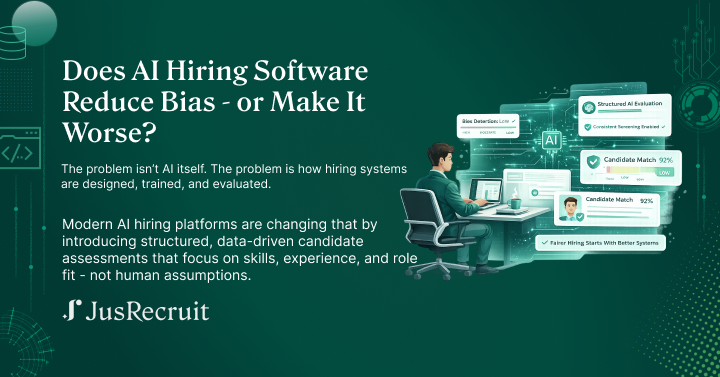
AI hiring software, when thoughtfully designed and implemented, consistently reduces bias in recruitment. By standardising early-stage evaluations, eliminating manual inconsistencies, and focusing on objective data, AI-led processes outperform traditional hiring methods in delivering fairer, faster, and more effective candidate selection.
Interest in AI for hiring has surged as organisations seek more reliable, efficient, and equitable recruitment solutions. With growing pressure to address unconscious bias and ensure equal opportunity, talent leaders are adopting AI phone screening, AI-first interviews, and automated applicant tracking systems (ATS) to deliver better outcomes. This shift represents a pivotal change in how hiring is done, and the debate over bias reduction and AI’s role is more important now than ever.
How Traditional Hiring Methods Introduce Bias
Manual hiring workflows are riddled with points where bias creeps in, often unintentionally. Each stage, from resume review to phone screening, is susceptible to subjective judgments, distractions, and human fatigue.
- Resume screening: Recruiters manually sift through hundreds of resumes, often relying on intuitive gut feel or poorly calibrated keyword searches.
- Telephonic screens: Inconsistent questioning and varying levels of attention compromise candidate evaluations.
- Interviews: Unconscious preferences for certain backgrounds, names, or communication styles distort results.
These inconsistencies frustrate strong candidates, dilute talent quality, and leave companies open to compliance and reputation risks. The old approach simply cannot match the consistency and scale required for unbiased hiring today.
How AI Actively Reduces Bias in Talent Acquisition
AI hiring solutions, powered by sophisticated algorithms, analyse candidate data without the distractions of human bias. Unlike manual processes, AI-led screenings and assessments use structured scoring criteria, focusing strictly on relevant skills, experiences, and attributes.
Standardisation Delivers Consistency
AI phone screening (Automated Telephonic Interviews) and first-round interview tools ask all candidates the same questions in the same structured way, ensuring everyone is evaluated on an equal footing. This removes variances that naturally occur when humans interact unsupervised.
- Consistent criteria applied to 100% of applicants
- Objective scoring against mapped role requirements
- No disadvantage due to name, accent, or school attended
Modern ATS platforms powered by AI also flag and remove biased language in job descriptions and assess candidate-pool diversity to promote fairer representation.
According to a Harvard Business Review study, structured AI-led assessments cut adverse impact by 30% and increase underrepresented group hiring by over 20% compared to unstructured manual interviews.
AI vs Manual Hiring: The Bias Comparison
To illustrate the clear benefits, compare traditional manual hiring with AI-powered workflows:
- Resume Shortlisting
- Manual: Prone to fatigue, overreliance on certain schools or companies, and missing high-potential candidates
- AI: Scores all resumes consistently, ignores non-predictive details, and systematically uncovers hidden talent
- Phone Screens
- Manual: Varying tone, question order, and subjective impressions lead to inconsistent results
- AI: Same questions, tone, and analytics every time, results are directly comparable across all candidates
- Interview Evaluation
- Manual: Interviewers often unconsciously favour those similar to themselves
- AI: Focuses on data-backed abilities relevant to the role, not subjective factors
The results are clear, with AI enabling faster, fairer, and more reliable shortlists while supporting recruiter productivity and candidate experience.
Candidate Benefits: Fairness and Transparency
Far from disadvantaging candidates, AI-powered hiring empowers them. Applicants experience reduced wait times, meaningful updates, and more objective feedback. Structured data enables recruiters to communicate how decisions were made, building trust and reducing ambiguity.
- Faster turnaround: AI can screen thousands of applications in minutes, moving top candidates to the next stage promptly.
- Structured feedback: Candidates receive clear, data-driven insights on why they advanced or did not.
- Equal opportunity: Each applicant completes the exact same evaluation steps, levelling the playing field.
This modern approach resonates with today’s talent, who expect accountable and inclusive processes throughout their job search.
Implementation Best Practices for Bias-Free AI Hiring
Leading hiring teams recognise that while AI is a powerful tool for bias reduction, optimal results require thoughtful design and governance. The key lies in how AI systems are built, trained, and monitored.
Key Success Factors
- Diverse training data: AI models should be trained on representative applicant pools to avoid legacy biases.
- Transparent criteria: Clearly define skills, competencies, and scoring logic, aligned to role requirements.
- Continuous audit: Regularly review AI outputs and candidate flows, correcting any new or emerging biases promptly.
- Candidate communication: Share the evaluation process with applicants for confidence and clarity.
Modern talent teams that adhere to these principles maximise the bias-reducing power of AI, delivering more equitable hiring outcomes than would ever be possible with manual processes alone.
Frequently Asked Questions
How does AI hiring software identify and address potential bias?
AI hiring systems use algorithms calibrated to focus strictly on skills, experience, and relevant qualifications. These tools ignore information that can introduce bias, such as name or graduation year, and automatically surface patterns in large datasets that signal unintended bias. By regularly auditing outputs, leading recruiters eliminate any drift toward unfairness.
Is there a risk that AI hiring tools inherit historical human bias?
While any AI trained on biased historical data could theoretically reflect those patterns, modern practices include comprehensive data auditing and selective feature engineering to eliminate this risk. Forward-thinking recruiters work closely with AI teams to ensure continuously fair and representative hiring results.
Are candidates comfortable with AI-driven screenings and interviews?
Most candidates appreciate the speed, objectivity, and structured feedback that AI-powered hiring offers. Because everyone goes through the same process, applicants perceive greater fairness and transparency. Leading talent teams also communicate clearly how AI is used, further increasing candidate confidence.
What regulatory or compliance standards support AI in hiring?
Jurisdictions increasingly support fair hiring mandates, and AI-driven processes help organisations comply with equal opportunity laws by documenting objective decision-making steps. Regular audits, explainable AI, and clear privacy safeguards further strengthen compliance.
Looking Ahead: The Future of AI-Driven, Bias-Free Hiring
AI-led hiring is decisively setting new standards for fairness, efficiency, and candidate experience in recruitment. Every recent innovation, from AI phone screens to predictive ATS workflows, has moved the industry closer to truly bias-free hiring. Companies embracing these technologies are attracting and selecting better talent, delivering faster results, and positioning themselves as employers of choice. The future of hiring belongs to those who confidently harness AI to realise equitable outcomes for all.