
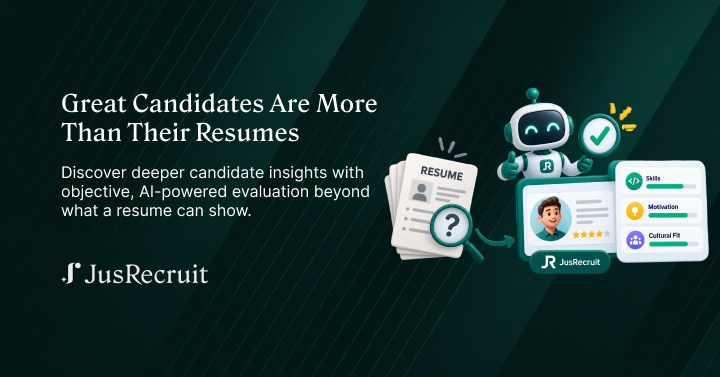
Resumes alone no longer provide enough depth to assess great candidates, as modern hiring requires deeper insights and objective evaluation. Leading teams now rely on AI-powered screening and assessments to uncover skills, motivation, and fit that are impossible to detect from a document or manual review. Companies adopting AI hiring workflows consistently outperform those sticking with resumes and traditional screening.
For decades, resumes stood as the gatekeeper to every career opportunity. Yet, as technology evolves and the workforce grows increasingly diverse and digital, exclusive reliance on resumes exposes hiring teams to inefficiencies and missed talent. Manual resume screening is not only slow but fails to capture the whole candidate. Modern organizations are turning to AI-driven methods, moving beyond the static resume to unlock richer candidate understanding and deliver more equitable, efficient, and effective hiring experiences.
Why Traditional Resume Screening Falls Short
Relying solely on resumes limits a hiring team’s ability to identify top talent. Traditional resume reviews are restricted to what a candidate chooses to document, missing soft skills, problem-solving capabilities, and cultural fit. Moreover, bias can creep in when recruiters unconsciously favor familiar schools, companies, or formats.
- Incomplete candidate profiles: Resumes rarely capture growth mindset, adaptability, or unique potential.
- Inconsistent evaluations: Manual reviews produce uneven results, as two recruiters can interpret the same resume differently.
- Bottlenecked timelines: Sifting through piles of resumes slows down the hiring process, risking the loss of top candidates to faster competitors.
- Outdated keyword filtering: Standard ATS filters catch buzzwords but miss adjacent or emerging skills critical in innovation-driven sectors.
- Recrafting of Resumes: Candidate are easily recrafting their resumes with the help of the JD provided and AI tools to get through the keyword matching technology. As a result, a lot of irrelevant profiles flow in.
AI-Powered Screening Provides Deeper, More Objective Insights
Modern talent teams trust AI-driven workflows to gain a multidimensional understanding of candidates. AI phone screening and structured AI-led interviews assess practical skills, communication abilities, and real-world problem-solving, offering data-driven confidence in shortlisting decisions.
Key Benefits Over Manual Screening
- Speed: Automated AI screening can review thousands of candidates in minutes, while manual methods take hours or days.
- Consistency: Every applicant faces the same criteria and unbiased evaluation, eliminating variability across recruiters or times of day.
- Rich candidate signals: AI gathers unique insights from conversational analysis, scenario-based questions, and behavioral data, revealing strengths not visible on paper.
- Immediate feedback: Candidates receive prompt updates and next steps, enhancing their experience and your employer brand.
According to recent industry research, organizations using AI-driven screening report a 35 percent reduction in early-stage bias and fill critical roles up to 40 percent faster than those relying on resume-based methods.
The Candidate’s Perspective: Faster Responses, Fair Assessment, Better Experience
Modern candidates expect tailored interactions and rapid responses. With manual resume reviews, candidates are often left waiting or are never contacted. AI accelerates response time and removes subjectivity from early evaluations, creating a candidate-centric hiring process.
- Accelerated communications: AI-powered ATS platforms automatically update applicants on their status, keeping them engaged.
- Transparent feedback: Structured digital interviews provide actionable, unbiased feedback – something resumes cannot enable.
- Equal opportunity: Every applicant is considered against the same well-defined criteria, rather than filtered by surface-level document details.
Contrast: Manual Processes Versus AI-Driven Hiring
Understanding the difference in outcomes between traditional and AI-based hiring is critical for recruiting leaders.
- Before (manual): Reliance on resumes, manual keyword searching, and subjective scoring. High time investment, frequent oversight, and quality candidates slipping through the cracks.
- Now (AI-driven): Advanced parsing, tailored assessments, behavioral analysis, and skill-based scoring. Lower time-to-shortlist, elevated candidate pools, and quantifiable improvements in hiring outcomes.
This shift is why forward-thinking recruiters consistently report a competitive advantage in talent acquisition. They focus energy on final candidate selection and relationship building, not endless sifting through resumes.
Integrating AI into Your Hiring Workflow
Adopting AI-driven approaches does not mean erasing resumes completely. Instead, resumes become just one data point among many. AI phone screening, digital interviews, and smart ATS workflows combine to provide a holistic view of each candidate, making manual resume screening obsolete as a first filter.
Best Practices for High-Impact AI Hiring
- Standardize criteria: Use structured questions and data-driven scoring to ensure fairness and focus evaluations.
- Update workflows: Integrate AI-based tools at the very start of your funnel, not just as an afterthought.
- Train hiring staff: Upskill your recruiters and interview panels to interpret AI-driven insights and focus on high-value conversations with candidates.
- Prioritize candidate experience: Make sure communication is prompt, expectations are set, and feedback is constructive.
By making AI the backbone of your early-stage hiring, you dramatically improve both efficiency and quality of hire.
Frequently Asked Questions
How does AI screening identify great candidates beyond the resume?
AI screening assesses a candidate’s verbal responses, behavioral cues, and responses to real-world scenarios through automated phone interviews and structured digital interactions. This provides objective data on communication skills, problem-solving, and motivation that resumes cannot offer.
Does relying on AI tools eliminate bias in hiring?
While no process is entirely bias-free, AI reduces early-stage bias by applying standardized criteria at scale. Leading hiring teams find that AI-driven screening mitigates subjective decisions that can result from manual resume reviews.
Will candidates have a better experience with AI-based screening?
Yes. Candidates benefit from faster feedback, transparent selection criteria, and fair evaluation. AI-powered workflows eliminate the frustration of endless waiting and inconsistent communication common in traditional processes.
Are resumes still useful in an AI-driven hiring workflow?
Resumes remain a supporting reference but are no longer the primary filter. In high-performing teams, AI evaluates skills and suitability first, with recruiters reviewing resumes only for final context.
The Future of Hiring: AI-Driven Assessment as the New Standard
The most effective talent organizations have already moved beyond resumes as the sole indicator of fit or potential. By adopting AI-led screening, integrating structured digital interviews, and automating repetitive tasks, hiring teams gain a decisive edge in selecting great candidates and delighting applicants. The path forward is clear: the companies who embrace AI-powered hiring workflows set the bar for effectiveness, fairness, and candidate experience, leaving manual resume-driven hiring firmly in the past.